
MUSEUMS & CULTURE
American Museum of Natural History: Tickets, Route, and How Long You Really Need
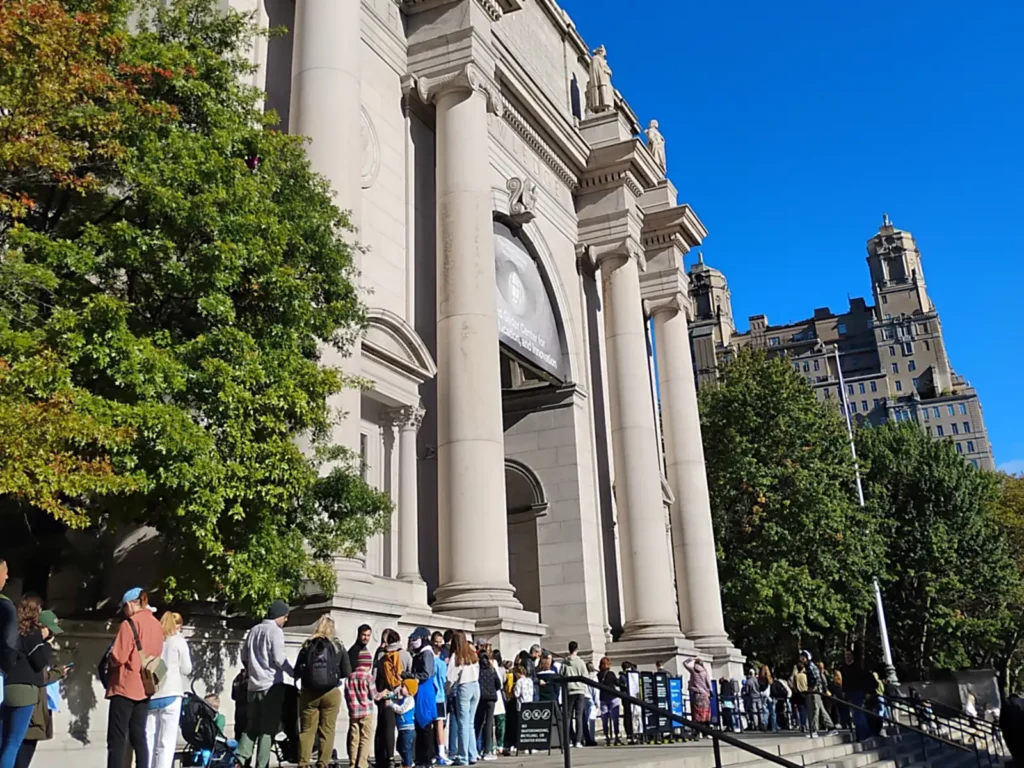
Most people arrive at the American Museum of Natural History with a ticket, a vague plan to see the dinosaurs, and no idea that the planetarium show is a separate purchase.
Four hours later they are on the fourth floor, tired, and have missed the one hall that would have stopped them in their tracks. Some of them have paid $37 when they could have paid whatever they wanted, and most have walked straight past the room holding the largest meteorite on public display anywhere in the world.
This guide fixes that before you go. What admission actually costs in 2026, seven legitimate ways to pay less, a floor by floor route that puts the best halls first, and honest time estimates for four different kinds of visit.
The short answer
- $37 for adults. New York State residents pay what they wish for general admission, with ID.
- The last hour of the day is free for everyone. A ticket is still required.
- The planetarium show, the butterfly vivarium and Invisible Worlds are not included.
- Residents cannot add those online. It has to be done at a ticket desk after you arrive.
- SNAP recipients get a free one-year membership, not a discount. It is the best-value option in the building.
- Start on Floor 4 and follow the black line painted on the floor.
- Check the closure list the morning you go. It changes weekly.
American Museum of Natural History tickets and what you actually pay
Standard general admission is $37 for adults. That is the number to plan around unless you live in New York State.
The museum splits its pricing into two tracks, and almost every confusion about AMNH tickets comes from people reading the wrong one.
Standard pricing, for visitors from outside New York State
|
Ticket |
Adult |
Senior / Student |
Child, 3 to 12 |
|---|---|---|---|
|
General Admission |
$37 |
$30 |
$22 |
|
General Admission + one ticketed exhibition |
$43 |
$35 |
$26 |
|
General Admission + all ticketed exhibitions |
$48 |
$39 |
$30 |
New York State resident pricing, pay what you wish
|
Ticket |
Adult |
Senior / Student |
Child, 3 to 12 |
|---|---|---|---|
|
General Admission |
$25 suggested |
$20 suggested |
$14 suggested |
|
General Admission + one ticketed exhibition |
$30 |
$24 |
$17 |
|
General Admission + all ticketed exhibitions |
$35 |
$28 |
$20 |
For residents, general admission is genuinely pay what you wish. The $25 is a suggestion, not a floor. The accepted forms of ID are a driver’s license, a state ID card, IDNYC, a student ID, a current utility bill showing your address, or a voter registration card.
Booking the resident rate online works differently from a normal purchase. You tick the New York State residents box, enter an eligible zip code, choose Pay What You Wish, then enter the amount you want to pay.
Two definitions catch people out. Student admission applies to students of any age with a valid student ID, not just school-age children, and senior admission starts at 60 rather than 65.
You will see $28 quoted as the adult price on a number of travel sites. That figure is out of date. So is the claim that pay what you wish extends to New Jersey and Connecticut residents. The resident rate now applies to New York State only.
Can you buy tickets at the door?
Yes. There is no rule against walking up and paying. But entry is timed, and security lines at the Central Park West steps can run fifteen minutes or longer on a weekend. Booking online in advance is the difference between walking in and standing outside.
Free and reduced admission: seven ways in
If you arrive at 4:30 PM you will not see the whole museum, but the fossil halls and the blue whale are comfortably doable, and the building empties out as you go. Here is the full list of ways to reduce or eliminate the fee.
1. The last hour
As above. Note that complimentary admission still requires a ticket.
2. Children under 3
Free, always.
3. Discoverer membership, for SNAP recipients
This is the most valuable and least reported option in the building, and it is not a discount. It is a free one-year membership.
If you are enrolled in the Supplemental Nutrition Assistance Program through New York State, show your New York State EBT card at a Museum Member Desk between 10:00 AM and 4:30 PM. A representative enrolls you on the spot, you receive a digital membership card, and you can start using it the same day.
- Free general admission to the 40+ permanent halls for you and up to four guests, every day
- Free entry to one ticketed exhibition on every visit, chosen from the Butterfly Vivarium, Invisible Worlds, the Hayden Planetarium Space Show, or Impact
- Member evening and morning hours, outside general public hours
- Use of a Member Entrance, which skips the main queue
- Discounts in the shop, the food court and the parking garage
Additional ticketed exhibitions beyond the first cost $10 each, purchased at a Membership Desk in person.
Here is the part worth noticing. Discoverer tickets, including the free ticketed exhibition, can be booked online before each visit. Pay-what-you-wish tickets cannot, as explained in the next section. A SNAP recipient is in a better planning position than an ordinary New York resident paying full price. The online limit is five Discoverer tickets per day, and the booking must include at least one adult ticket.
The program runs in collaboration with the NYC Department of Cultural Affairs and the NYC Human Resources Administration. Several guides still describe AMNH as offering $3 admission through Museums for All. That undersells it considerably. The museum went well past that model.
4. Culture Pass
Anyone aged 13 or over with a full-service New York Public Library, Brooklyn Public Library or Queens Public Library card can reserve a free Culture Pass, and AMNH is a participating institution. Two rules shape how you should use it. You get one pass per institution per calendar year, so a wasted AMNH reservation costs you the museum until January. And passes are released a month at a time, on the first of each month.
Culture Pass’s own terms page states that a cardholder may hold up to four active reservations at a time. The City’s Culture Pass page still says two. Neither has been reconciled. Assume two if you are planning tightly, and check at the point of booking.
5. IDNYC
Holders get waived admission. Tickets are still required, and there is a checkbox for it on the ticketing page.
6. Military
Admission is free for all members of the US military and their families during the Blue Star program, which runs from Armed Forces Day through Labor Day. Outside that window, free general admission covers a service member plus one guest.
7. Caregivers, Cool Culture, members and museum staff
All waived. Visitors with disabilities can also purchase admission at the student and senior rate on site or by phone.
What general admission includes, and what costs extra
This is where most visitors get caught. The museum divides its exhibitions into two categories, and the difference is not obvious from the ticket page.
|
Included with general admission |
Requires a separate ticket |
|---|---|
|
Over 40 permanent halls |
Hayden Planetarium Space Show |
|
The Rose Center for Earth and Space building |
Davis Family Butterfly Vivarium |
|
Mignone Halls of Gems and Minerals |
Invisible Worlds immersive experience |
|
Arthur Ross Hall of Meteorites |
Impact: The End of the Age of Dinosaurs |
|
The fourth-floor fossil halls |
Included |
|
Apex Stegosaurus Fossil |
Included |
|
Milstein Hall of Ocean Life |
Included |
|
Akeley Hall of African Mammals |
Included |
The permanent halls in that left column do not change. The rest of the lineup does. The museum runs a rotating set of smaller included exhibitions alongside the permanent halls, and the ticketed list gains and loses shows as runs end. Both lists live on the museum’s exhibitions page, and that is the page to check rather than any guide, including this one.
Is the planetarium included?
No. The Rose Center building and its Earth and Space galleries are covered by general admission, and you can walk the Scales of the Universe ramp for free. The space show inside the sphere is a separate ticket for everyone, residents included.
Ticketed exhibitions cannot be added to a pay-what-you-wish ticket online. If you are a New York resident who wants the planetarium or the butterfly vivarium, you have two choices: buy a Resident Pricing ticket instead of pay what you wish, or go pay what you wish and buy the exhibition at a ticket desk after you arrive. Voucher and pass holders are in the same position.
That rule is buried in the museum’s admission FAQ and appears on essentially no other guide. It is the reason a lot of visitors end up standing in a second line.
On the CityPASS question
AMNH is one of two fixed attractions in the New York CityPASS, $164 adult and $136 child aged 6 to 17, valid nine consecutive days. The other fixed attraction is the Empire State Building, and you choose three more from a list that includes Top of the Rock, the Statue of Liberty and Ellis Island, the 9/11 Memorial and Museum, Circle Line, the Intrepid and the Guggenheim.
The CityPASS entry covers general admission and one ticketed exhibition, so the right figure to compare against is $43, not $37. That makes the pass better value than it first looks if you were going to see the space show anyway. It works considerably less well if you are a New York resident, because the pass is pricing in an admission you could pay whatever you like for.
How long do you need at AMNH?
Every guide gives a different number. You will see two hours, three, four, five and a full day, all stated with equal confidence. The reason is that they are answering different questions. Here is the honest breakdown.
|
Kind of visit |
Time |
What you get |
|---|---|---|
|
Highlights only |
2 hours |
Fossil halls, the blue whale, the Rose Center from outside |
|
A proper first visit |
3 to 4 hours |
The above plus dioramas, gems and minerals, one more floor |
|
With young children |
3 hours |
Fewer halls, more breaks. Do not push past this |
|
With a ticketed exhibition |
5 hours or more |
Add roughly an hour per show, including its entry time |
Three practical notes. Ticketed exhibitions have their own entry times, so they anchor your day rather than fitting into it. The building is genuinely large, spread across interconnected structures with five levels, and moving between floors costs more time than the map suggests. And you can leave and return on the same ticket the same day, though you re-enter at the 81st Street or Central Park West entrances and go back through security.
A floor by floor route through the museum
The museum’s free Explorer app gives turn-by-turn directions and can route you around elevators if you need them. A printable map is also available. But if you want a route that front-loads the best halls, here it is.
Floor 4: the fossil halls
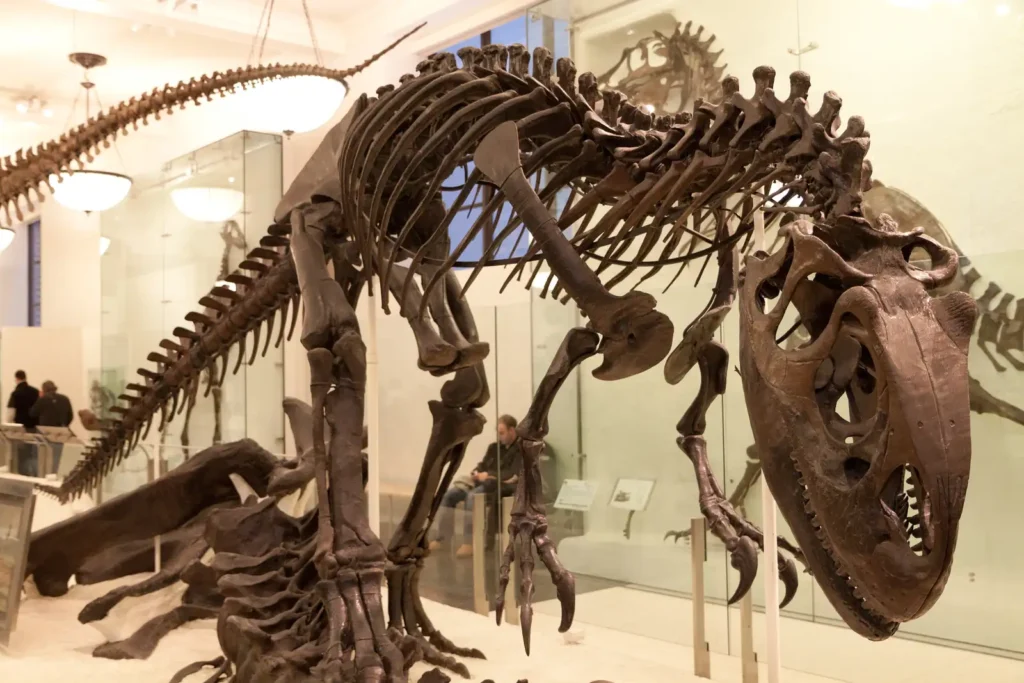
Two connected halls, Saurischian and Ornithischian Dinosaurs, holding one of the most significant fossil collections in the world. The T. rex is here.
Here is the thing almost nobody tells you before you walk in. The fourth floor is not arranged chronologically or by size. Its 600 or so specimens are laid out as a single giant family tree defined by evolutionary relationships, and there is a thick black line painted on the floor that runs the whole way through it.
Follow that line and you are walking the trunk of the tree, from the Hall of Vertebrate Origins through the two dinosaur halls and on into the Hall of Primitive Mammals and the Milstein Hall of Advanced Mammals. Every branching point marks the evolution of a new physical characteristic, and each branch leads into an alcove of closely related animals. The method is called cladistics, and it was pioneered with the help of the museum’s own scientists.
Once you know about the line, the fourth floor stops feeling random and starts reading like an argument. It is also worth knowing that 85 percent of what you are looking at is actual fossil rather than cast, which is unusually high for a museum this size.
The Titanosaur stands in the Wallach Orientation Center, not in the dinosaur halls themselves. It is a life-sized cast of Patagotitan mayorum, 122 feet long, from a specimen found in Argentina in 2014, and it has been in place since 2016.
Apex, a Stegosaurus that lived around 150 million years ago, is thought to be the largest and one of the most complete Stegosaurus fossils ever uncovered. It sits where the Gilder Center opens into the fossil halls, and the display includes a back plate cast you are allowed to touch.
Floor 3: the Hall of Primates and the upper dioramas
The upper level of the African Mammals hall looks down into it, which is the best angle on the elephants.
Floor 2: the Akeley Hall of African Mammals
Covered in its own section below. Do not rush this one.
Floor 1: the Milstein Family Hall of Ocean Life
The 94-foot blue whale model has hung here since 1969, weighs 21,000 pounds, and the room is dark and cool enough that it works as a genuine rest stop halfway through.
Look past the whale and there is far more here than most visitors notice. The hall runs to 29,000 square feet and holds models of more than 750 sea creatures, along with 14 classic dioramas and eight ocean ecosystem displays ranging from Indo-Pacific coral reef to the bioluminescent fishes of the deep sea.
Nearby, the Hall of Biodiversity holds the Spectrum of Life display and a walk-through diorama, and the Hall of North American Forests and the Warburg Hall of New York State Environment carry the same diorama tradition into closer-to-home landscapes. These halls are quieter than the fossil floors and often skipped entirely.
Floor 1: the Mignone Halls of Gems and Minerals
More than 5,000 specimens from 98 countries, all included with any admission.
The Star of India is here. At just over 563 carats it is the largest gem-quality star sapphire known, and its star is well enough defined to be visible on both sides of the stone, which is rare. The effect, called asterism, comes from needle-like inclusions inside the gem, and it only shows properly because the stone is cut as a rounded cabochon rather than faceted.
Nearby stand two amethyst geodes that have quietly become the halls’ most photographed objects. One weighs roughly 11,000 pounds. Its slightly taller sibling weighs 9,040.
Floor 1: the Arthur Ross Hall of Meteorites
Also included with any admission, and the hall most first-time visitors walk straight past. It holds more than 130 scientifically significant meteorites, plus rare Mars specimens and Moon rocks brought back by the Apollo missions.
Its centerpiece is Ahnighito, a 34-ton fragment of the Cape York meteorite found in Greenland in 1894 and the largest meteorite on display anywhere in the world. It is so heavy that its supports do not rest on the museum floor at all. They run straight down to the bedrock underneath the building.
It is around 4.5 billion years old, which makes it very nearly as old as the Sun, and it is one of three Cape York fragments in the room. The others are known as the Woman and the Dog. The original meteorite is estimated to have weighed about 200 tons before it broke apart in the atmosphere.
The same hall has a scale model of Arizona’s Meteor Crater, cut away so you can see how an impact crater forms. When that site was identified as an impact crater in the early twentieth century it changed how scientists thought about the whole solar system, because researchers began arguing that impacts had cratered the Moon and the planets too. It is a small display that quietly explains a very large idea.
The Gilder Center
The newest wing, entered from Columbus Avenue, holds an insectarium, the butterfly vivarium and the Invisible Worlds experience. The atrium itself is worth walking through even if you skip the ticketed parts.
The Rose Center for Earth and Space
The glass cube. The Scales of the Universe walkway is included with admission and gives you the sense of scale that the space show then builds on.
Are the animals real? Inside the dioramas
Yes, and the story behind them is the reason to slow down on Floor 2.
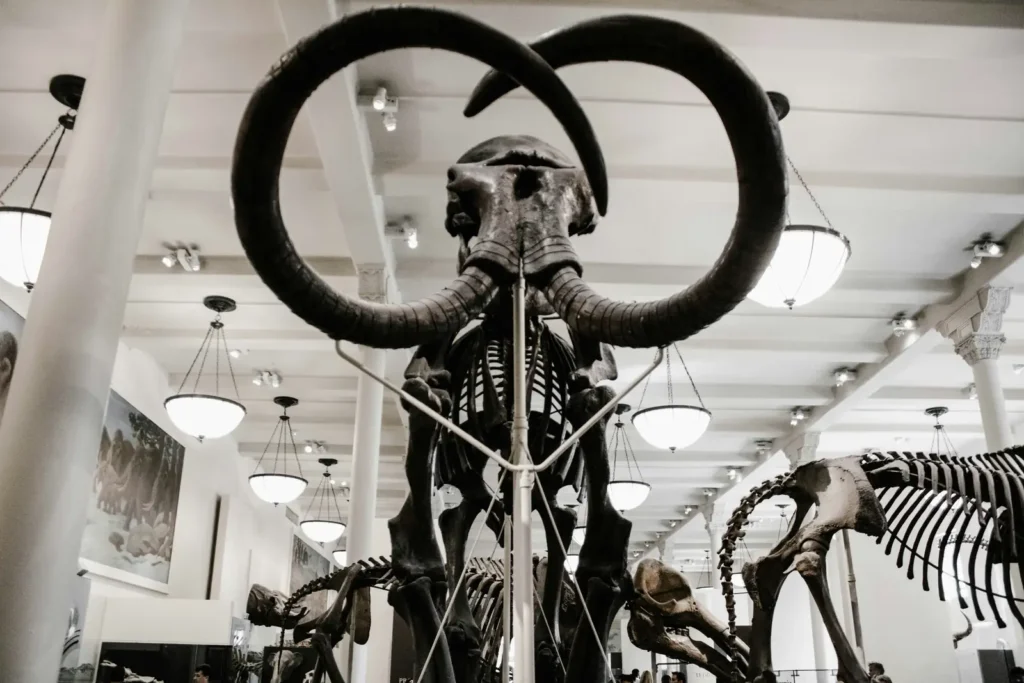
The specimens in the habitat dioramas are real animals, preserved through taxidermy. But stuffed is the wrong word, and the difference matters. The technique was developed by Carl Akeley, generally credited as the father of modern taxidermy. His method meant taking precise measurements of an animal, making plaster impressions, and using bones from its own skeleton to build a lifelike clay sculpture, over which the skin was then fitted. The result looks not just real but alive.
He made the first habitat diorama in 1889, a group of muskrats in a marsh, while working at the Milwaukee Public Museum.
The Akeley Hall of African Mammals opened in 1936. At its center stands a freestanding group of eight elephants, surrounded by 28 habitat dioramas across two floors. None of these scenes is invented. Each re-creates a specific place, based on the field observations of scientists working in Africa in the early twentieth century together with the on-site sketches and photographs of the artists who travelled with them, and each is lit to represent a particular time of day at that location.
Akeley conceived the hall in 1909 and never saw it. He died in 1926 on Mount Mikeno, in what is now the Democratic Republic of the Congo, a decade before the hall opened. That mountain is the one depicted in the mountain gorilla diorama he designed. By that final expedition he had become a determined advocate for the protection of the gorillas he had gone there to study.
The dioramas also carry a harder history. The animals were collected on expeditions in the 1910s and 1920s, shot for display, at a time when the conservation argument being made was that the wild was vanishing and needed recording. The museum does not hide this, and standing in front of the elephants with that in mind is a different experience than walking past them.
When to go, and the closures nobody warns you about
Weekday mornings are quietest. Crowds build through the late morning and peak around the middle of the day.
One reliable signal you can plan around: school groups arriving by subway are admitted through the 81st Street station entrance from Monday to Friday, between 10:00 AM and 2:00 PM, and the fossil halls are where most of them go first. If you want Floor 4 to yourself, be on it at opening. Saturday afternoons on Floor 4 are the worst combination of everything.
If you cannot make the morning, the late afternoon works well, and it overlaps with the free final hour.
Now the part almost no guide covers. The museum publishes a temporary hall closure list and updates it weekly. Halls close for maintenance, for events, and sometimes for longer policy reasons.
Closed indefinitely, Floor 3
- The Hall of Eastern Woodlands
- The Hall of the Great Plains
Both are closed in connection with NAGPRA regulations governing the display of Native American cultural items and human remains. This is not a maintenance item and there is no scheduled reopening date. The museum has published a statement explaining it.
The rest of the list turns over constantly. Individual galleries, the Gilder Center wing, the vivarium and the restaurant all appear on it for a few days at a time through the year.
Getting there, parking, bags, and food
Entrances
Three are open. The 77th Street entrance is currently closed, which several guides have not caught up with.
|
Entrance |
Step-free |
Notes |
|---|---|---|
|
Central Park West at 79th St |
No, steps |
The grand one. Longest security line |
|
81st St, Rose Center |
Yes |
Best for strollers |
|
Columbus Ave, Gilder Center |
Yes |
GPS: 415 Columbus Avenue. No driveway |
The museum’s own visitor page gives two different street numbers for the 81st Street entrance. It is listed as 54 West 81st Street in the stroller guidance and 56 West 81st Street in the Access-A-Ride and GPS section. They are a few doors apart on the same block, so either will get you there, but do not assume you have the wrong address if your app disagrees with a sign.
Public transport
- Subway: B, weekdays only, or C to 81 St
- Subway: 1 to 79 St and Broadway, two blocks west
- Bus: the M79 crosses the park east to west and stops on West 81st Street. The M7, M10, M11, M86 and M104 also stop nearby
- Accessibility: the 81 St station is not wheelchair accessible. Use 72 St on the 1, 2 or 3, then the northbound M7 on Amsterdam Avenue
Parking
The garage entrance is on 81st Street between Central Park West and Columbus. It opens 6:00 AM to 11:00 PM on weekdays and 8:00 AM to 11:00 PM at weekends. Free EV charging is available on the mid-level through the ChargePoint app, so set up an account before you arrive.
|
Duration |
Rate |
|---|---|
|
Up to 2 hours |
$33 |
|
2 to 5 hours |
$40 |
|
5 to 10 hours |
$50 |
|
Maximum to close |
$55 |
|
Oversized, over 6’ 5” |
$20 extra |
Rates include NYC parking tax.
Bags, strollers, photos
- Large bags, backpacks and luggage are not allowed in the galleries
- Lockers cost $7 small and $12 large per day and are available until 5:00 PM. No food or drink can be stored
- Strollers are welcome except in theaters. Double strollers are not allowed in ticketed exhibition galleries
- Photography for personal use is fine. No selfie sticks, tripods or lights, and no photography at all in the Hayden Planetarium Space Theater or the LeFrak Theater
- Bike racks are in the Rose Center driveway. Scooter racks are outside the 81st Street entrance
- Free guided tours run throughout the day
Food
Four options, each with its own closing days. Worth checking before you plan lunch around one of them.
|
Where |
Hours |
Closed |
|---|---|---|
|
The Restaurant at Gilder, Floor 2 |
11:30 AM to 3:30 PM |
Mon, Tue |
|
Food Court, Lower Level |
10:45 AM to 4:45 PM |
Open daily |
|
Cafe on 1 |
11:00 AM to 4:30 PM |
Wed, Thu |
|
Cafe on 4 |
11:00 AM to 4:30 PM |
Mon, Tue |
Eating is not allowed in the galleries. Members get 15 percent off. The Restaurant at Gilder takes reservations.
AMNH, Central Park, and the Met in one day
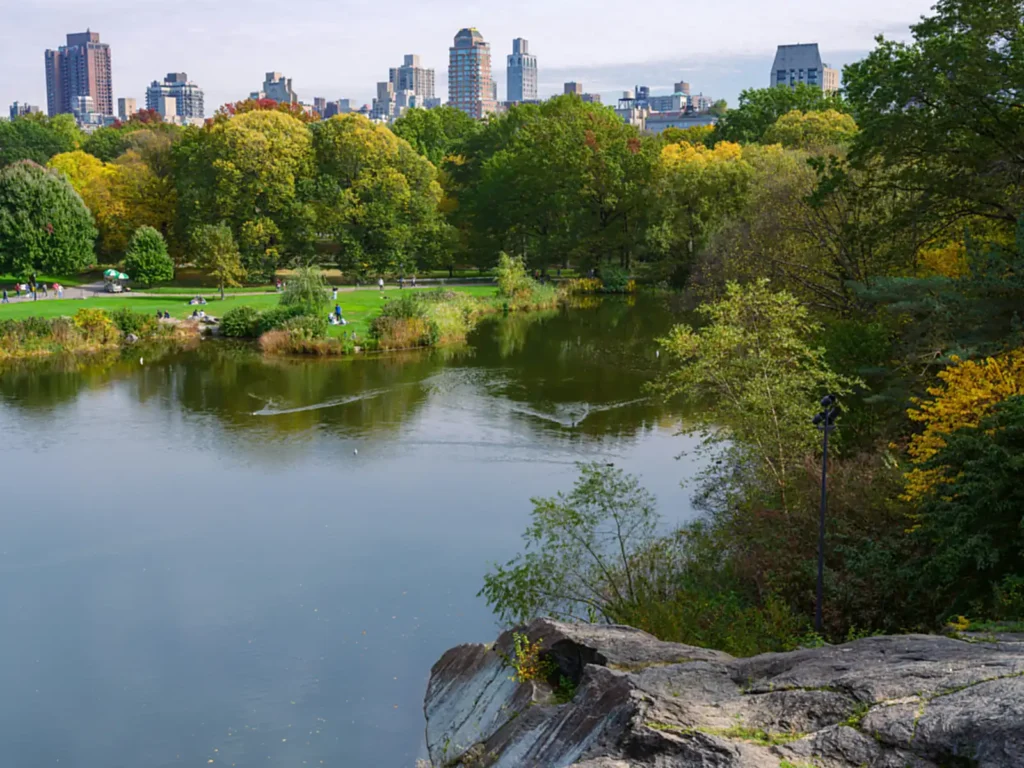
The museum sits in Theodore Roosevelt Park with Central Park directly across Central Park West. The Metropolitan Museum of Art is on the other side of the park, a crosstown walk or a single M79 bus ride away.
That geography makes one of the better days in Manhattan possible without a single subway transfer. Open AMNH at 10:00 AM and give it three hours, fossil halls first. Walk east into Central Park across the 79th Street transverse, with the Ramble and Bethesda Terrace both on the way. Arrive at the Met by mid-afternoon.
This one sends people to the wrong building. The Temple of Dendur, the mummies and the Egyptian galleries are all across the park. AMNH’s cultural halls cover the peoples of Africa, Asia, the Pacific and the Americas, which is a different collection entirely.
If you only have time for one, choose by what you want to look at. AMNH is science, deep time and the natural world. The Met is art and human civilization. They are not substitutes for each other.
Questions people actually ask
Before you go
The American Museum of Natural History rewards a small amount of preparation more than almost any attraction in New York. Know which track you are on for tickets, know that the planetarium and the vivarium cost extra, start on the fourth floor, and check the closure list the morning you visit.
Do those four things and the difference between a good visit and a frustrating one is largely settled before you walk through the door.
Prices, hours, dining times, parking rates, entrance details and closures verified against the museum’s own site on 1 September 2026. Hall and specimen details come from the museum’s own exhibition pages. Pass pricing comes from NYC Tourism. Prices and closures change, so check the museum’s live closure list on the morning you visit. How we research every guide.

