
MUSEUMS & CULTURE
The Metropolitan Museum of Art: Tickets, Hours, and a Route
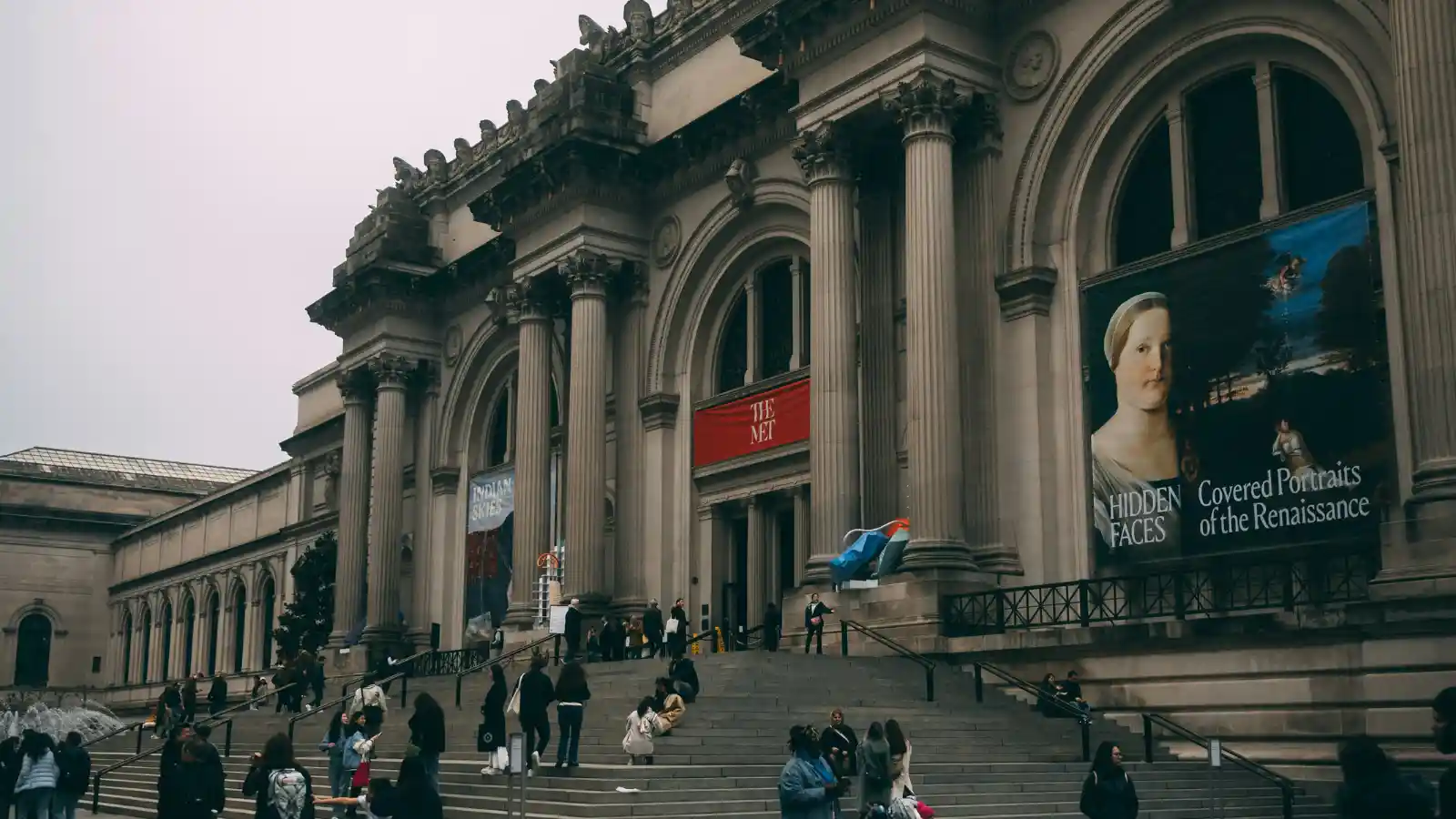
Two million objects. Seventeen departments. Two million square feet of floor. You are not going to see The Metropolitan Museum of Art, and the sooner you accept that, the better your visit gets.
The mistake first-time visitors make is trying to be thorough. They buy a ticket, take a map, and start at the first gallery they find. Three hours later they have walked four miles, seen a great deal of pottery, and missed the Temple of Dendur entirely.
This guide takes the opposite approach. It gives you one route through the building that hits the pieces you came for, the real 2026 prices with the discounts most guides leave out, and an honest list of what is closed right now, because a lot of what you will read elsewhere is describing galleries you cannot currently walk into.
The short answer
- Closed Wednesdays. Every week, all year. The most common wasted trip in New York museum visiting.
- Enter at 81st Street, not the Fifth Avenue steps. Same ticket, shorter queue.
- $30 for adults, free for children 12 and under, and free for the care partner of a visitor with a disability.
- All special exhibitions are included. No separate ticket, no surcharge.
- You do not need to book ahead. The museum says so itself, whatever other guides tell you.
- The Roof Garden is closed until 2030. Ignore anything that recommends it.
Before anything else: what is closed
Start here, because this is the part that ruins visits.
Closed as of August 2026
- The Cantor Roof Garden
- The Modern and Contemporary Galleries
- The Ancient West Asia and Ancient Cyprus Galleries
The Roof Garden is the one that matters, and the detail almost every guide gets wrong is how long it is gone for.
The Iris and B. Gerald Cantor Roof Garden closed to the public on 19 October 2025 and is not expected to reopen until 2030. It is not being repaired. It is being demolished, along with the Lila Acheson Wallace Wing beneath it, to make room for the $500 million Oscar L. Tang and H.M. Agnes Hsu-Tang Wing, a five storey building designed by the Mexican architect Frida Escobedo. When the roof terrace returns it will sit on the fourth floor and be larger than the old one.
If you have read a guide recommending a cocktail at the Martini Bar above Central Park, that guide has not been checked since 2025, which tells you something about the rest of it.
The museum publishes a live closure list, and closures move as departments are reinstalled. Check it the morning you go, not the week before.
The two hour route
If you have one visit and no particular expertise, walk this. It moves in one direction through the building, ends near the exit, and covers the five things most people came to see.
Enter through the 81st Street entrance, not the grand staircase on Fifth Avenue. Same building, same ticket, far shorter queue, and it puts you closer to the start of this route.
Egyptian Art and the Temple of Dendur
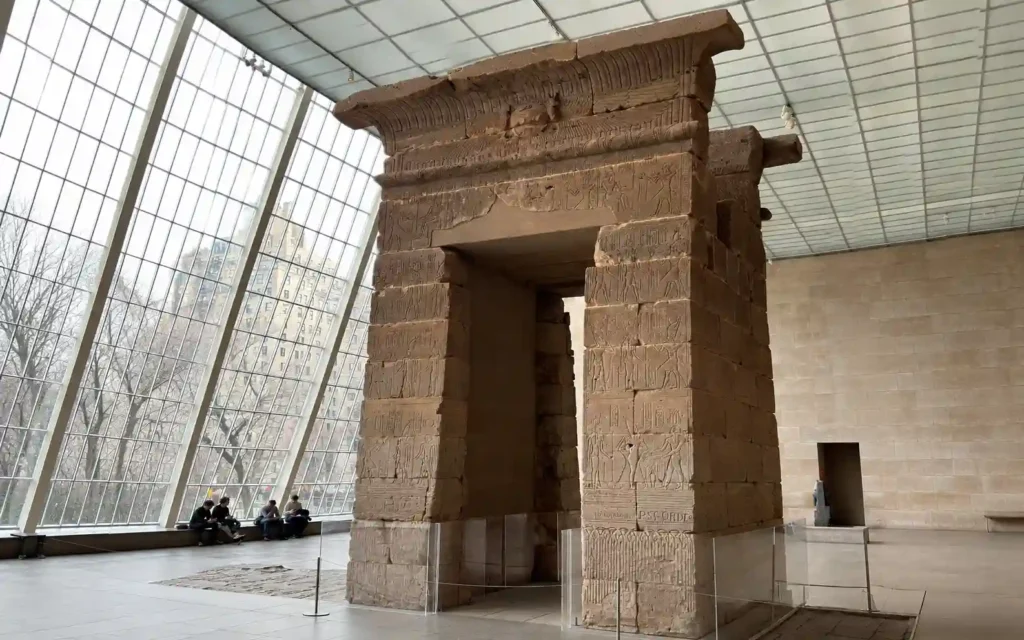
The Egyptian wing runs the length of the north side of the ground floor, room after room of small dark cases, and then the ceiling lifts and you walk into a glass hall with an entire Egyptian temple standing in it. The change of scale is the point, and it works on almost everyone.
The Temple of Dendur was completed around 10 CE. In the 1960s the Aswan High Dam was about to put its site under water, so it was cut into blocks, shipped, and rebuilt here. The sloping glass wall behind it faces Central Park, and the shallow pool in front stands in for the Nile.
Light comes through the glass wall at an angle for the first couple of hours. It is the reason this room looks the way it does in every photograph you have seen of it.
Arms and Armor
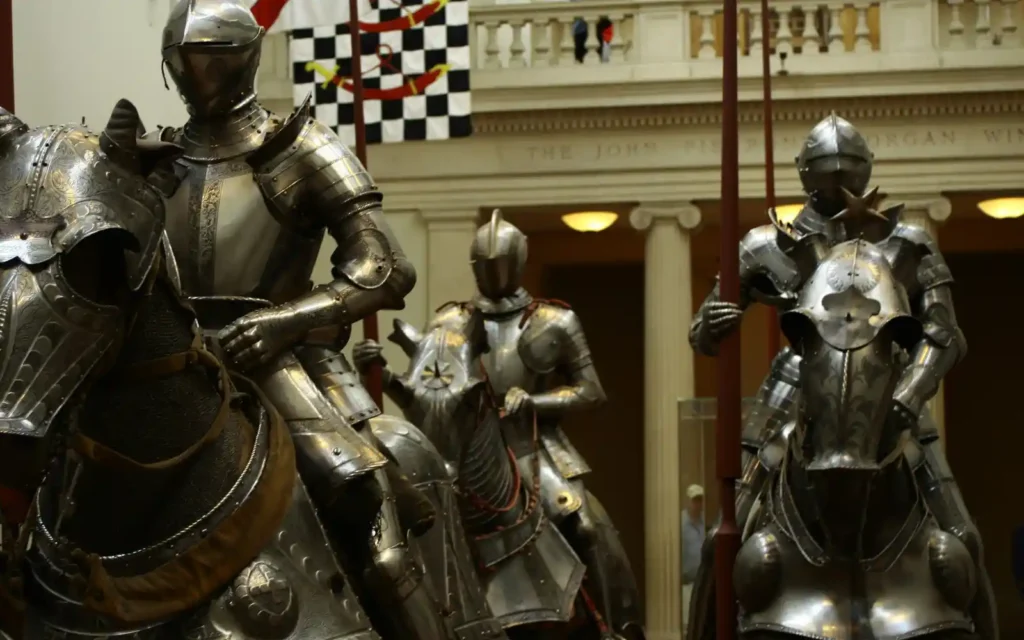
A complete change of mood. Four knights in full plate armor sit on armored horses in the middle of the hall, arranged as though mid-procession, and the wall cases hold parade armor made for European kings who were never going to fight in it.
This is the gallery that holds a restless child longest, and it takes fifteen minutes rather than an hour.
The American Wing
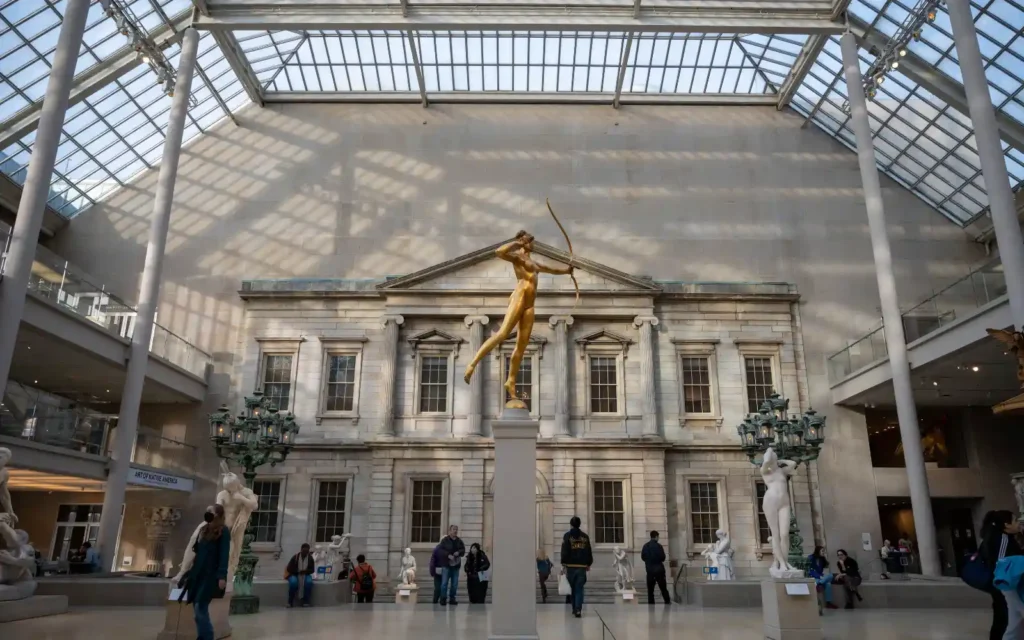
The Charles Engelhard Court is a glass-roofed courtyard with the marble facade of an 1820s bank built into one wall, and the noise of the museum drops away the moment you step into it. It is also one of the very few places in the building where you can sit down for twenty minutes without buying anything, which matters more than it sounds by hour two.
Upstairs are twenty period rooms recreating three hundred years of American domestic life, including a Frank Lloyd Wright living room from 1912 with the furniture built into the walls. Washington Crossing the Delaware hangs on this floor. It is twelve feet high and twenty-one feet wide, and nobody who has only seen it in a textbook is prepared for that.
European Paintings
This is the densest hour in the building: Vermeer, Rembrandt, Bruegel, Caravaggio, Velázquez, room after room of them.
It is also where museum fatigue usually arrives, so be ruthless. If you stop at three, make them Vermeer’s Young Woman with a Water Pitcher, Bruegel’s The Harvesters, and Velázquez’s portrait of Juan de Pareja, bought by the museum in 1971 for what was then the highest price ever paid for a painting. The Velázquez is a portrait of an enslaved man who was himself a painter, and it holds a room in a way reproductions do not.
Nineteenth Century European
Van Gogh, Monet, Degas and Cézanne run through a series of connected rooms, and this is the stretch most visitors have been waiting for.
Expect crowds around Van Gogh’s Self-Portrait with a Straw Hat and Degas’s Little Fourteen-Year-Old Dancer. The Monet water lily bridge usually has nobody in front of it, and at full size it is the better painting to sit with.
From here the stairs take you down to the Great Hall and out. If you have anything left, Central Park starts across the road.
What the Metropolitan Museum of Art costs
Admission changed in 2018, when the museum stopped being pay-what-you-wish for everyone. The current structure has more categories than most guides list, and two of them are worth real money to the right person.
|
Visitor |
Price |
|---|---|
|
New York State residents |
Pay what you wish |
|
New York, New Jersey and Connecticut students |
Pay what you wish |
|
Adults |
$30 |
|
Seniors, 65 and over |
$22 |
|
Visitors with a disability, in person only |
$22 |
|
Students |
$17 |
|
Children, 12 and under |
Free |
|
Members and Patrons |
Free |
|
Care partner of a visitor with a disability, in person only |
Free |
Two of those rows almost never appear in travel guides: children under 13 are free, and a care partner accompanying a visitor with a disability is free. If you are a family of four with two children, your visit costs $60, not $120.
How pay what you wish actually works
This is the most misunderstood part of visiting The Met, and getting it wrong costs real money.
- You must pay something. The minimum is one cent per ticket. It is not free admission, it is admission at a price you choose.
- Who qualifies: New York State residents, and students from New York, New Jersey or Connecticut.
- Online is not the same as in person. To buy pay-what-you-wish tickets online you need a New York State billing address. New Jersey and Connecticut students cannot do it online at all. They must go to the admissions desk in person with a valid student ID.
- What counts as proof for New York residents: a New York State driver’s license, a New York State identification card, IDNYC, a current bill or statement showing a New York State address, a student ID, or a New York library card. That last one surprises people.
How pay what you wish actually works
Almost every guide tells you to book timed-entry tickets in advance. The museum’s own site says the opposite: advance tickets are not required.
The price is identical online and at the door, so booking online buys you one thing, which is walking past the ticket line straight to a gallery entrance. On a February Tuesday that is worth nothing. On a Saturday in July it is worth twenty minutes.
What your ticket includes
One ticket covers all exhibitions and same-day entry to both Met locations, Fifth Avenue and The Cloisters, for the date printed on it.
That first part is worth more than it sounds. Most major museums sell special exhibitions separately and charge $25 or more on top of admission. The Met does not. Every temporary show running on the day you visit, including the Costume Institute’s headline exhibition, is covered by the same $30 ticket. There are usually around thirty shows on at once. Nobody puts this on a poster, and a lot of visitors walk past exhibitions assuming they cost extra.
The dual-location part used to be a three-day ticket. It is not any more, and plenty of older guides still say it is. If you want both buildings on one ticket, they have to happen on the same day, and The Cloisters is a forty minute trip north.
Groups of ten or more must register in advance, as must any third-party guided tour of any size.
Getting there
The museum sits on the eastern edge of Central Park, which is why it pairs naturally with a park walk. The American Museum of Natural History is directly across the park on the west side, a single M79 bus ride away.
|
Coming from |
Route |
|---|---|
|
East Side |
4, 5 or 6 to 86 St, then three blocks west. Half a mile, about ten minutes |
|
From Midtown |
Q to 86 St on Second Avenue. A slightly longer walk, but a far emptier train |
|
West Side |
1 to 86 St, then the M86 crosstown bus through the park |
|
West Side, alternative |
C to 81 St, then the M79 bus through the park |
|
Grand Central |
4, 5 or 6 to 86 St, or the M1 to M4 buses up Madison |
|
By bus |
M1, M2, M3 or M4 along Fifth Avenue to 82nd Street |
The subway is not close. The 86th Street station is three long blocks away, a ten minute walk. Guides that say “take the 4, 5 or 6 to the museum” leave out the half mile.
Parking is a trap. The garage at Fifth Avenue and 80th Street only opens weekday evenings from 6 pm and all day at weekends, so it is shut during weekday museum hours. Clearance is six feet six inches. Bikes park free in racks inside the same garage.
Rules that catch people out
|
Rule |
What it means |
|---|---|
|
Bags |
Small backpacks allowed, but must be worn on your front or carried by hand. Coat and bag check are free |
|
Drinks |
Water in a secure bottle only. No other liquids, no outside food |
|
Photography |
Non-flash photos and video for personal use are fine in most galleries. Images cannot be sold or used commercially |
|
Photo shoots |
Staged shoots, including engagement and modeling photography, are not permitted |
|
Strollers |
Welcome, and so are front-facing baby carriers. Jogging strollers and wagons are banned, and some exhibitions bar strollers entirely |
|
Smoking |
Prohibited inside and near the entrances, e-cigarettes included |
|
Your ticket |
Keep it. You may be asked to show it again when you leave and re-enter the galleries |
|
Sitting |
Not on the floor. Benches are scattered through the galleries and the American Wing courtyard |
That ticket rule is worth repeating. People step outside for air, throw the ticket away, and cannot get back in.
When to go
- Weekday mornings at opening. The doors open at 10:00 AM and the first hour is the quietest of the day.
- Friday and Saturday evenings are the other good window. The museum stays open until 9:00 PM, and the galleries after seven are noticeably calmer than a Saturday afternoon.
- Avoid rainy Saturdays. Every indoor attraction in Manhattan fills up when the weather turns, and this one fills up faster than most.
- Remember Wednesday. It is closed. This is the single most common wasted trip in New York City museum visiting.
The Cloisters, and whether to bother
Your ticket includes The Met Cloisters, a separate building in Fort Tryon Park at the northern tip of Manhattan, assembled from parts of four genuine French medieval cloisters.
|
What The Met Fifth Avenue means |
The Met Cloisters |
|
|---|---|---|
|
Focus |
Everything, 5,000 years |
Medieval Europe only |
|
Location |
1000 Fifth Avenue |
Fort Tryon Park, Washington Heights |
|
Getting there |
86 St subway |
A train to 190 St |
|
Atmosphere |
Vast and busy |
Quiet, garden-led |
|
Time needed |
2 to 3 hours |
2 hours |
Do not attempt both in one day. The ticket allows it, but you will lose ninety minutes to travel and arrive too tired to look at anything. Pick one, and if this is your first trip to New York, pick Fifth Avenue.
Practical details
- Food. The American Wing Café and the Petrie Court Café are the sit-down options, both moderate to expensive. Fifth Avenue and Madison have cheaper choices within two blocks.
- The digital guide is the Bloomberg Connects app, free on iOS and Android, with an interactive floor map. Download it before you arrive rather than on museum wifi.
- Free tours run daily and are included with admission. Check the board in the Great Hall.
- Accessibility. Step-free entrances are at 81st Street and through the 80th Street garage. Manual wheelchairs, standard and wide, are free at 81st Street on a first come first served basis. Mobility scooters and service dogs are welcome.
- Membership starts at $90 a year with unlimited entry, so it pays for itself on the fourth visit.
Questions people actually ask
Before you go
The Metropolitan Museum of Art rewards people who choose. Pick five things, walk to them in one direction, sit down when you are tired, and leave while you are still interested.
Everything you skip will still be there. The building has been collecting since 1870 and is in no hurry.
Hours, prices, closures and entry rules verified against the museum’s own site in August 2026. Subway and bus routes come from the MTA. Gallery closures move as departments are reinstalled, so check the museum’s live closure list on the morning you visit. How we research every guide.

