
TOP ATTRACTIONS
Walking the Brooklyn Bridge: Entrances, Timing, and What Changed in 2026
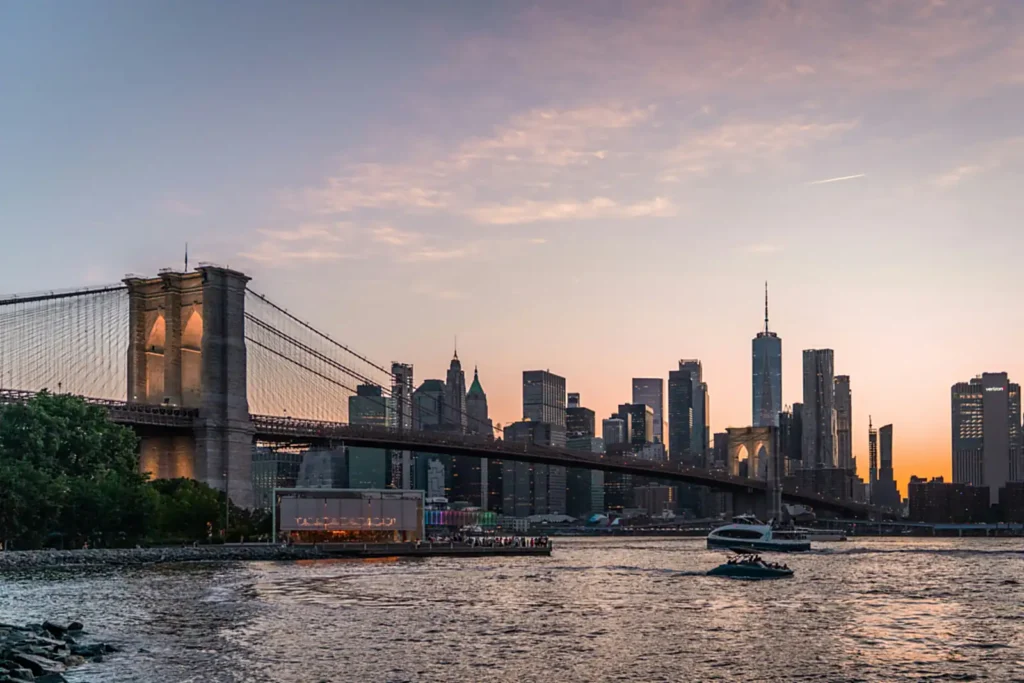
Almost every guide to walking the Brooklyn Bridge tells you to start in Brooklyn at the Washington Street entrance in DUMBO. Almost none of them mention that this entrance is a staircase.
If you are pushing a stroller you cannot carry, or using a wheelchair, you will walk to it and find you cannot use it.
That is the sort of thing this guide is for. Below: every entrance and which ones have steps, how long the crossing actually takes, what the crowds look like in official numbers rather than adjectives, how to get back, and what changed at the Manhattan end in 2026.
The short answer
- Free. No ticket, no booking, no fee of any kind.
- Open at all times. The promenade does not close, even during rehabilitation work.
- Walk Brooklyn to Manhattan so the skyline is in front of you.
- Step-free entrances: Centre Street in Manhattan, Tillary Street at Adams Street in Brooklyn. The DUMBO entrance is stairs.
- Allow 30 to 45 minutes, longer than a mile suggests, because everyone stops at the towers.
- There are no vendors and no restrooms. Bring water.
- The Manhattan entrance was rebuilt in 2026. Cyclists and pedestrians now have separate approaches.
Every entrance, and which ones have steps
There are more ways onto this bridge than most guides list, and they are not equally usable.
Manhattan side
|
Entrance |
Notes |
|---|---|
|
Centre Street at Park Row |
The main pedestrian entrance, by City Hall Park. Ramp |
|
Centre Street at Chambers Street |
Closer to Chinatown and the Lower East Side |
|
Pearl Street at Frankfort Street |
Nearest South Street Seaport |
|
Park Row underpass |
Stairs. Cuts roughly ten minutes off the walk from the east |
NYC DOT’s own description of the 2026 redesign refers to pedestrian access to both ramps at the Manhattan entrance, so the ramped approach on this side is officially confirmed.
Brooklyn side
|
Entrance |
Step-free |
Notes |
|---|---|---|
|
Tillary Street and Adams Street |
Yes, ramp |
Longer walk from DUMBO. The path runs between traffic lanes |
|
Washington Street at Prospect Street |
No, stairs |
The popular one. Directly connects to DUMBO |
On some maps Adams Street appears as Brooklyn Bridge Boulevard. Almost nobody uses that name, so ask for Adams Street.
Entrances with stairs
- Washington Street at Prospect Street, the DUMBO entrance most guides recommend
- The Park Row underpass on the Manhattan side
Several large travel sites say the bridge is wheelchair accessible with ramps on both sides. That is true, but the way they say it is misleading, because the same guides recommend starting at the DUMBO entrance, which is stairs.
The Brooklyn ramp is at Tillary and Adams. NYC DOT’s own history of the promenade dates it to the 1980s, when the ramp to Adams and Tillary was added and the old stairs to the towers were removed. The Manhattan ramps are confirmed in DOT’s 2026 redesign material. Both sides are documented. The DUMBO entrance simply is not one of them.
Which direction should you walk?
Brooklyn to Manhattan. The skyline is in front of you the entire way rather than behind you, and every photograph you take is the one you actually wanted. This is close to unanimous advice and it is correct.
The trade-off is that finding the Brooklyn entrance is genuinely harder than finding the Manhattan one. The Manhattan entrance is a wide, obvious approach next to City Hall Park. The Brooklyn entrances are tucked under overpasses and poorly signposted, which is why so many first-time visitors end up circling.
If you have limited time, limited patience for navigation, or you are arriving by subway into Lower Manhattan anyway, walking Manhattan to Brooklyn is a perfectly good crossing. You just look over your shoulder more.
How long the walk takes
The pedestrian path is about 1.1 miles. What that means in time depends entirely on what you stop for.
|
Kind of walk |
Time |
|---|---|
|
Straight across, steady pace |
25 to 40 minutes |
|
Normal pace with photographs at the towers |
45 to 60 minutes |
|
With young children |
Closer to 90 minutes |
|
There and back on foot |
1.5 to 2 hours |
Two things stretch the estimate. The approaches are long, so you walk a while before you are properly over water. And the two stone towers are where everyone stops, so the middle third of the crossing is slower than the ends whether or not you plan to stop yourself.
There are benches along the promenade if you need to sit.
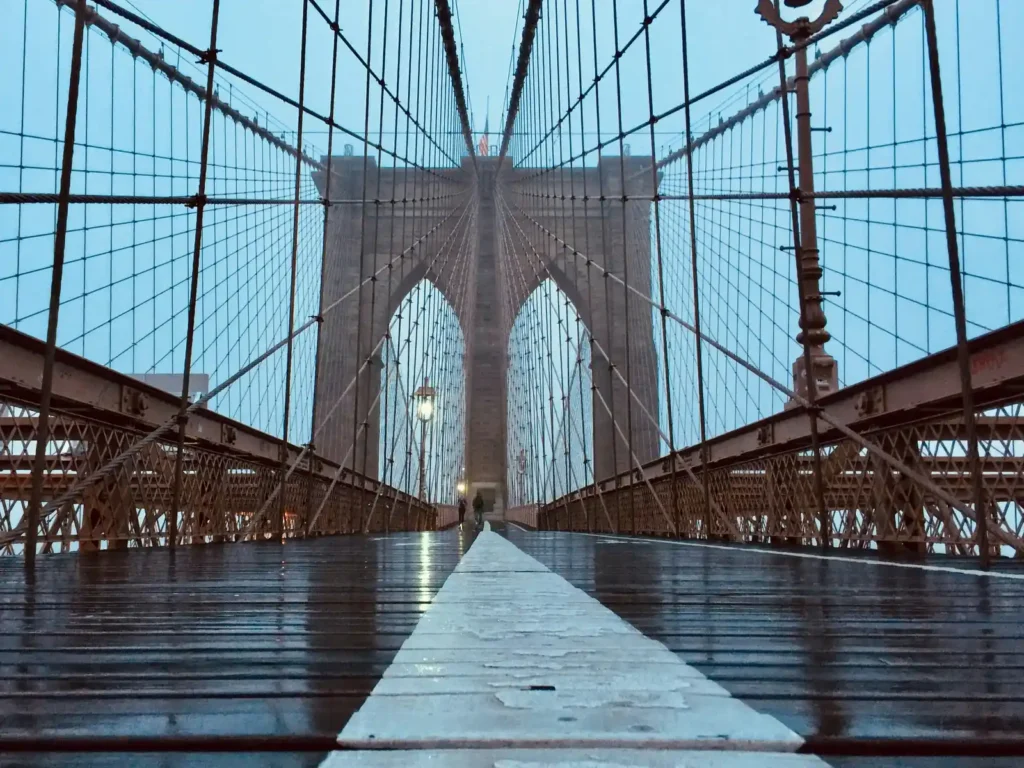
When to go, and how crowded it really is
Most guides tell you the bridge gets crowded. Here is what that means in official numbers.
|
Users |
Per day |
|---|---|
|
Pedestrians, NYC DOT 2024 average |
28,845 |
|
Pedestrians, Mayor’s Office 2026 |
Nearly 30,000 |
|
Cyclists, NYC DOT 2024 average |
5,504 |
|
Cyclists, city figure for 2025 |
5,625 |
|
Vehicles, NYC DOT 2024 average |
103,051 |
Both sets of pedestrian figures are official and both are correct. They are from different years, and the direction of travel is upward. When the bike lane opened in 2021, the city described the promenade as carrying about 10,000 pedestrians a day. It is now roughly three times that.
Cycling has grown faster still. The city counted 2,652 daily cyclists in 2021 and 5,625 in 2025, more than double in four years.
Best and worst times
|
Time |
What it is like |
|---|---|
|
Before 8 am |
Quietest by a wide margin. Joggers and commuters, few tourists |
|
Weekday mornings, 7 to 9 am |
Commuter cyclists using the bike lane. Fine on foot |
|
Tuesday to Thursday afternoons |
The comfortable middle ground |
|
Weekend midday |
The most crowded it gets. Slow-moving groups stopping mid-span |
|
Sunset |
Most beautiful and most crowded at once |
|
After dark |
Quiet again, towers lit |
Sunrise gives you the best of both: the light falls on the Manhattan skyline rather than behind it, and the promenade is close to empty.
What changed at the Manhattan entrance in 2026
Pedestrians and cyclists now have separate entrances on the Manhattan side. This is recent, and no guide currently ranking in search results covers it.
The change came in two stages.
In September 2021 the city opened a two-way protected bike lane on the bridge itself, taking over one lane of car traffic. The promenade, shared by cyclists and pedestrians for decades, became pedestrian-only.
That fixed the crossing but not the arrival. Cyclists coming down into Manhattan were still funnelled into the same crowded plaza as everyone on foot, forced into a hairpin turn through people walking on and off the bridge.
On 27 March 2026, Mayor Zohran Mamdani and NYC DOT Commissioner Mike Flynn announced a redesign to fix exactly that, timed ahead of the FIFA World Cup. The plan added a dedicated bike connection along Centre Street and doubled the width of the southern crosswalk between the bridge and City Hall Park. It converts a left-turn bay on southbound Centre Street, between Chambers Street and the bridge entrance, into a two-way protected bike lane.
The city said work would begin in the spring and be finished ahead of the tournament’s June start. If you last crossed here before 2026, the Manhattan approach will not look the way you remember it.
NYC DOT’s own Brooklyn Bridge page still lists Contract 7 under “Current Projects,” a rehabilitation contract described as running until 2023. That page has not caught up. For anything recent about this bridge, the Mayor’s Office news releases are more current than the DOT project page.
The bridge itself
Walking across is free. There is no ticket, no timed entry, and nothing to book. NYC DOT owns and operates the bridge and charges no tolls on its bridges.
The promenade is open at all times. DOT’s project notes state the walkway stays open even during rehabilitation work, though sections can be narrowed while crews are on site.
|
Measure |
Figure |
|---|---|
|
Main span |
1,595.5 feet |
|
Clearance at center |
135 feet |
|
Vehicle lanes |
Five since 2021, no trucks permitted |
|
Pedestrian promenade |
About 1.1 miles |
On the vehicle lanes: the bridge carried six lanes of traffic for decades. One Manhattan-bound lane became the protected bike lane in 2021, which is why the figure is five today and six in older material.
NYC DOT gives the total length of the bridge and its approaches as 6,016 feet. The nomination the US Department of the Interior submitted to UNESCO gives 5,989 feet. Neither has been reconciled, and guides quote both without noticing. The main span, 1,595 feet, is consistent across both.
The promenade is shorter than the full structure because the approaches ramp down to street level well inland on both sides.
One correction worth making: the bridge lands in Brooklyn Heights, not DUMBO. DUMBO is where many walkers end up, but that is a choice of exit.
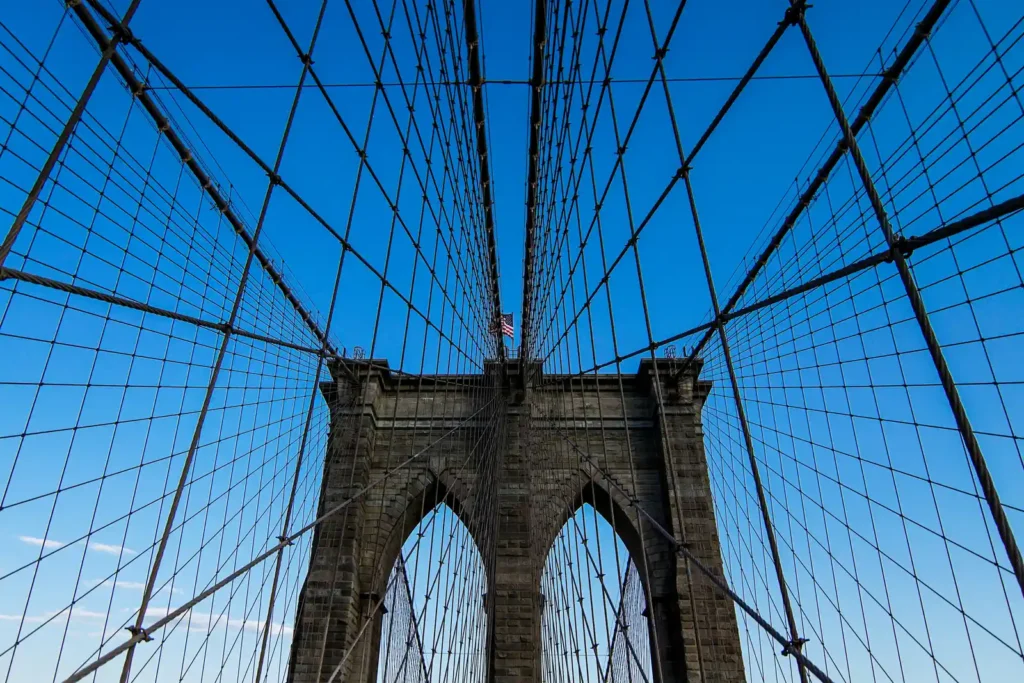
What you pass on the way across
Construction began in January 1869 and the bridge opened on 24 May 1883, designed by John A. Roebling. At the time it was the longest suspension bridge in the world.
The Roebling story is worth carrying with you between the towers. John Roebling designed the bridge and did not live to see it built. His son Washington took over and was disabled by decompression sickness contracted in the caissons sunk into the riverbed. Washington’s wife, Emily Roebling, carried the project through its final years, relaying instructions and dealing with the engineers directly.
The stone towers are the reason this crossing feels different from any other bridge walk in the city, and they look different now than they did five years ago. A four-year, $300 million restoration scrubbed decades of dirt and soot from every individual stone and brick, and replaced the mortar between them using material from the same quarry that supplied the original. The towers had been brown for generations. They are now back to their original light grey.
Fifty-six LED lights were installed on the towers at the same time, lit for the first time since the bridge’s centennial in 1983. The 166 necklace lights along the cables had already been converted to LED in 2021. If your mental picture of this bridge comes from older photographs, it will look lighter than you expect, especially after dark.
Three separate landmark designations sit on this structure: National Historic Landmark in 1964, New York City Landmark in 1967, and National Historic Civil Engineering Landmark in 1972.
You will read that it is, including in NYC DOT’s own press material, which describes the bridge as a UNESCO World Heritage site more than once.
That is wrong. The United States placed the Brooklyn Bridge on UNESCO’s Tentative List on 12 April 2017, submitted by the Department of the Interior. A tentative listing means a country intends to consider a site for future nomination. It is not an inscription, and the bridge has never been inscribed.
If a fact this checkable is wrong on a government page, it is worth being careful with the rest of what you read about this bridge.
One thing to skip: you will read about Cold War-era supplies found sealed inside the bridge. That space is inside the Manhattan anchorage and is not open to the public. Good story, not something you can find on your walk.
Getting back, and what is next door
Most people walk one way and take transit back. Deciding that in advance is the difference between a good afternoon and a tired one.
From the Manhattan side. The bridge entrance sits beside the Brooklyn Bridge–City Hall and Chambers Street subway complex, served by the 4, 5, 6, J and Z, with the 1, 2 and 3 reachable from Chambers Street nearby.
From the Brooklyn side. The nearest subway stations and the NYC Ferry both serve the DUMBO and Brooklyn Heights area. Check current service before you rely on a particular station, since the surrounding streets have ongoing construction.
If you walk back. Budget the same time again, and remember the light will have changed. Brooklyn to Manhattan at sunset and back after dark is a genuinely good way to do it.
Brooklyn Bridge Park begins essentially where the bridge lands on the Brooklyn side, and is the natural place to sit down afterwards. It has its own piers, free kayaking, food, and skyline views, and deserves more than a paragraph here. Read the Brooklyn Bridge Park guide for what is actually worth your time.
One thing to watch: the city is beginning long-planned repairs to the Brooklyn-Queens Expressway and has said it will build temporary bypasses to preserve access to Brooklyn Heights Promenade and Brooklyn Bridge Park during construction. Access should hold, but the streets around it will change.
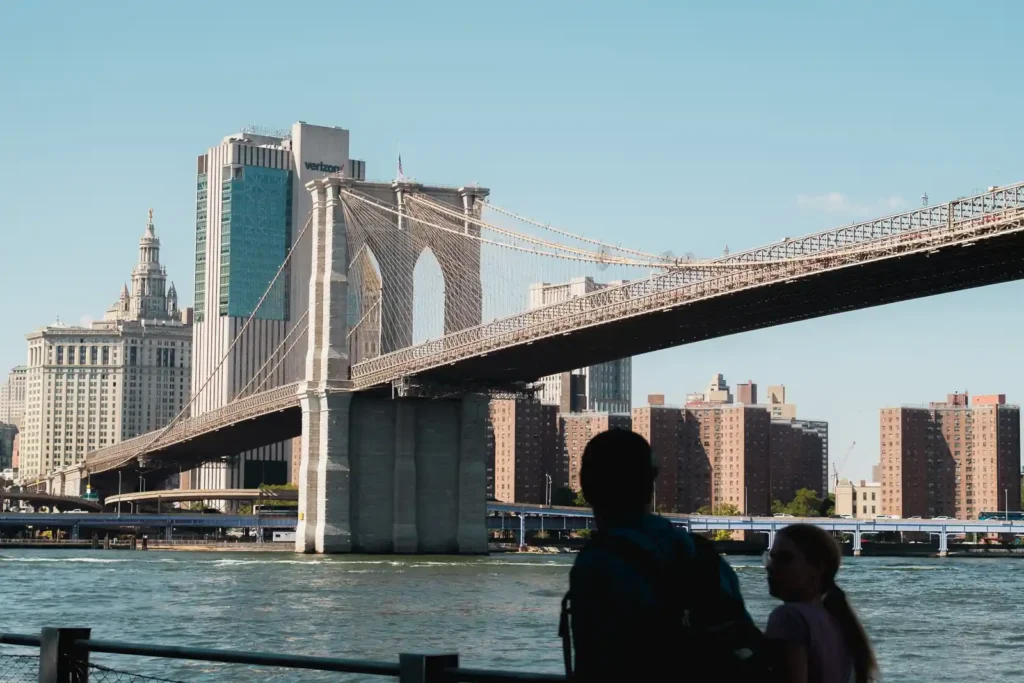
Rules and practical notes
Do not sit or stand on the ledges
There is no railing between the promenade ledges and the roadway below. People climb onto them for photographs anyway. It is the single most dangerous thing visitors do on this bridge, and it endangers the traffic underneath as well as the person posing.
Do not attach love locks
They damage a protected landmark, they are cut off, and you can be ticketed for attaching one.
Stay out of the bike lane
Cyclists have their own protected lane on the roadway, separate from the promenade. Since 2021 it has carried over a million trips a year. Stepping into it for a photograph is the most common way visitors cause a problem.
There are no vendors
Since January 2024, vending has not been permitted on pedestrian walkways and bike lanes on city bridges. Guides written before that still tell you to expect stalls selling water and souvenirs.
Restrooms
There are none on the bridge. On the Brooklyn side, the restroom listed in NYC Parks’ official directory is the Pier 6 Building in Brooklyn Bridge Park, with three toilets in the men’s room, six in the women’s, and a changing table in each. Pier 6 is at the far southern end of the park, roughly twenty minutes’ walk from where the bridge lands, so it is not a quick stop.
On the Manhattan side, no City Hall Park restroom appears in the NYC Parks restroom directory. Several guides state there is one. Plan on using a cafe instead.
Weather and photography
There is no shelter anywhere on the crossing. Wind over the East River is stronger than at street level, and there is no shade in summer. For photographs, the cable geometry works better from between the towers than at them, and there is usually room to stand there.
Questions people actually ask
Before you go
Walking the Brooklyn Bridge is one of the few genuinely free things to do in New York that is also one of the best. Pick your entrance before you leave rather than after you arrive, allow more time than a mile suggests, and decide how you are getting back before you start.
Do that and the crossing gives you the city from an angle nothing else does.
Dimensions, crossing figures, entrance details, restoration work and landmark status verified against NYC DOT, the NYC Mayor’s Office, NYC Parks and the UNESCO World Heritage Centre on 3 September 2026. Construction and access arrangements around this bridge change frequently, so confirm current conditions on the official sources before you travel. How we research every guide.


