
Parks & Outdoors
Things to Do in Central Park: A Route That Actually Works
843 acres, and most visitors see almost none of it. Here is the walk that gets you to the parts you came for, with the subway stops and the real prices.
Most people leave Central Park slightly disappointed, and it is almost never the park’s fault.
They arrive without a plan, walk in through whichever gate is nearest, wander for forty minutes past trees and joggers and a lake they cannot name, then head back out to Fifth Avenue wondering what everyone else saw. The park is 843 acres. It runs 2.5 miles from south to north and half a mile across. Walking the perimeter loop alone takes 6.1 miles of shoe leather.
The good news is that the things to do in Central Park that people actually travel for are not scattered across those 843 acres. They sit in a tight cluster in the lower middle of the park, and if you enter at the right gate you can reach the first one in under five minutes.
The short answer
- Enter at West 72nd Street, off the B or C train. Not the 1, 2, 3 station of the same name.
- Walk Strawberry Fields to Bethesda Terrace to Bow Bridge to the Mall. Two hours, four landmarks.
- The park is free. Only the zoo, rentals, tours and carriages cost money.
- A carriage ride is capped by law at $72.22 for 20 minutes, then $28.89 per 10 minutes.
- Go before 9:00 AM. It is a different park by noon.
The two hour route
If you only walk one path through this park, walk this one. It links four of the five most photographed places in the park and ends beside two world class museums. Ninety minutes at a steady pace, two hours if you stop.
Enter at West 72nd Street. Take the B or C train to 72 St. You come out on Central Park West, directly across from the gate.
Strawberry Fields
The Imagine mosaic sits just inside. It is a memorial to John Lennon, who lived across the road at the Dakota and was shot outside it in 1980.
Two things surprise visitors. The mosaic is small, roughly the size of a large rug, and there is almost always somebody standing at its edge. And the noise of the Upper West Side falls away faster than you expect. This is one of six designated quiet zones in the park, along with Sheep Meadow, East Green, Turtle Pond, Shakespeare Garden and the Conservatory Garden.
Bethesda Terrace and Fountain
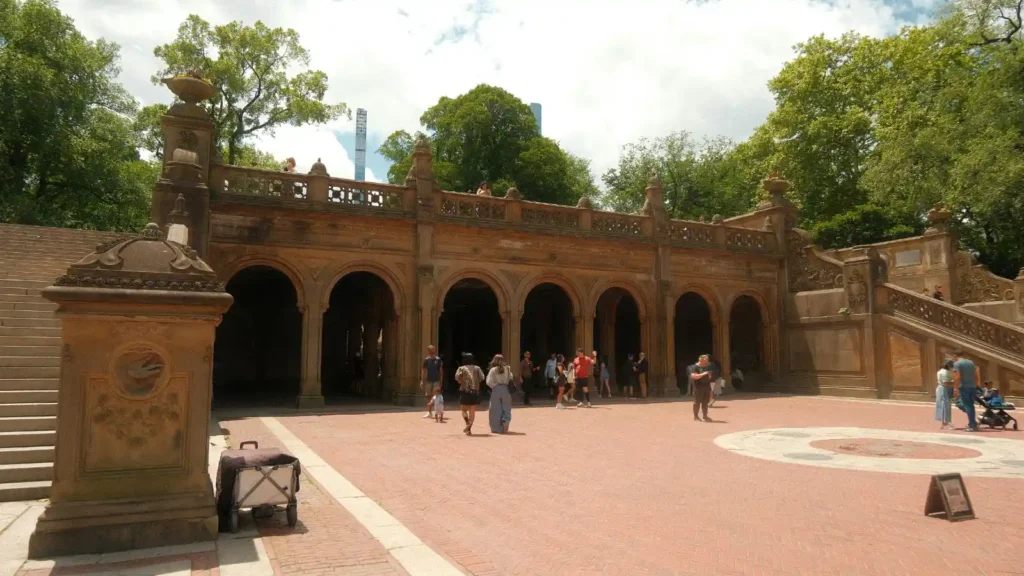
Follow the path east and the woodland suddenly opens into the only formal architecture in the entire park.
Here is the detail almost everyone walks straight past. Go under the lower arcade and look up. The ceiling holds roughly 16,000 Minton encaustic tiles set into 49 panels. It is the only tiled ceiling of its kind installed outdoors anywhere in the world.
The fountain is drained and switched off through the cold months. If you visit between December and March, expect an empty basin. The terrace and the tile ceiling are open all year.
The Lake and Bow Bridge
Bow Bridge is the cast iron span you have seen in films. The bridge is narrow and gets crowded from mid morning, so photographs work best before 9:00 AM. The skyline view everyone photographs is taken looking south from the middle of the bridge, not from the shoreline.
The Mall and Literary Walk
The only straight formal promenade in the park. The American elms arching overhead form one of the largest surviving stands of that tree in North America, which is why this path looks the way it does in October.
Choose your exit
End of route- Fifth Avenue at 82nd Street for the Metropolitan Museum of Art
- Central Park West at 79th Street for the American Museum of Natural History
- South to 64th Street for the Central Park Zoo
Which subway stop for which landmark
“Take the subway to the park” is useless advice for a green space served by fifteen subway lines. Use this instead.
|
You want to see |
Station |
Lines |
Walk |
|---|---|---|---|
|
Strawberry Fields, Bethesda, Bow Bridge |
72 St |
B, C |
1 min |
|
Columbus Circle, Sheep Meadow |
59 St / Columbus Circle |
A, B, C, D, 1 |
At the gate |
|
The Zoo, Wollman Rink |
5 Av / 59 St |
N, R, W |
4 blocks |
|
Belvedere Castle, Great Lawn, the Met |
86 St |
B, C or 4, 5, 6 |
2 min |
|
Conservatory Garden, Davis Center |
110 St |
6 or 2, 3 |
2 min |
There are two stations called 72nd Street. The one you want is the B/C station on Central Park West. The 1, 2 and 3 station at 72nd and Broadway is a different station three long blocks west, and it adds ten minutes of walking. Visitors mix these up constantly.
There is no parking inside the park. All park drives have been permanently closed to cars.
What costs money, and what it actually costs
Nearly everything here is free. These are the exceptions, with verified prices.
Central Park Zoo
|
Ticket |
Full admission |
Limited admission |
|---|---|---|
|
Adult (13 and over |
$22.95 |
$15.95 |
|
Senior (65 and over) |
$18.95 |
$12.95 |
|
Child (3 to 12) |
$16.95 |
$9.95 |
|
Child (2 and under) |
Free |
Free |
Limited Admission is the cheaper tier, it does not include the 4-D Theater, and it is sold online only. Adding the theater afterwards costs $7 per person, which wipes out most of the saving.
Horse drawn carriage rides
This is where visitors lose the most money in this park, and it is entirely avoidable. Carriage fares in New York City are capped by law. As of 3 May 2025 the maximum is:
Drivers may not charge more. The fare is per carriage, not per person, with a maximum of four adults.
|
Ride length |
Legal maximum |
|---|---|
|
20 minutes |
$72.22 |
|
30 minutes |
$101.11 |
|
40 minutes |
$130.00 |
|
50 minutes |
$158.89 |
|
60 minutes |
$187.78 |
Almost every travel guide online still quotes figures like $118.97 for a fifty minute ride. Those come from operator websites and predate the 2025 rate change. Resale platforms are a separate problem: one listing currently advertises a fifty minute ride at $320, roughly double the legal maximum.
Two more things worth knowing. Carriages cannot legally operate above 89°F or below 19°F, and drivers are often sent home earlier than that in a heatwave, so keep a backup plan in July. And under Executive Order 56, signed in September 2025, the NYPD was directed to prioritize enforcement against carriages that operate outside legally designated areas. If a driver approaches you away from an official stand, walk on.
Rowboats on the Lake
Rented from the Central Park Boathouse at East 72nd Street. $25 per hour Monday to Thursday, $30 per hour Friday to Sunday. Card or Apple Pay only, no cash. First come first served, up to four people, roughly April to October. Older guides still quote $12 or $20 per hour. Those prices are years out of date.
What you can skip
Most guides will not tell you this. Here it is plainly.
- The Ramble, if you are short on time. Thirty six acres of deliberately confusing woodland. Best birdwatching in Manhattan, but it swallows twenty minutes and gives you nothing photogenic.
- Belvedere Castle, unless you are already at the Great Lawn. A small folly rather than a castle. Worth a stop in passing, not a dedicated walk.
- Pedicabs. Fares are not capped the way carriage fares are, and arguments over the final bill are common.
When to visit
|
Season |
What you get |
Watch for |
|---|---|---|
|
Spring (Apr to May) |
Cherry blossoms, Conservatory Garden at peak |
Crowds build after mid May |
|
Summer (Jun to Aug) |
Shakespeare in the Park, rowboats, Gottesman Pool |
Carriages suspended above 89°F |
|
Fall (Oct to Nov) |
Peak foliage at Bow Bridge and the Mall |
The window is short and shifts |
|
Winter (Dec to Mar) |
Fewest people, Wollman Rink, real silence |
Bethesda Fountain drained |
The best hour of any day is the first one. The gates open at 6:00 AM. Bethesda Terrace and Bow Bridge are effectively empty before 9:00 AM and unrecognizable by noon on a summer weekend.
What changed in 2025
If you visited before 2025, the north end is a different place now. The Davis Center at the Harlem Meer opened on 26 April 2025, replacing the Lasker Rink and Pool that ran from 1966 until 2021. At $160 million it is the largest project the Central Park Conservancy has ever undertaken, and it changes function three times a year.
- Late June to early September: the Gottesman Pool, free to swim, 11:00 AM to 7:00 PM
- Late October to March: the Gottesman Rink
- Spring and fall: the Harlem Oval turf field
Demolishing Lasker reconnected the North Woods to the Harlem Meer for the first time in almost sixty years. The northern third of the park is now the quietest section of the whole landscape. Take the 6 train to 110 St if you want this park without the crowds.
Central Park rules you should know
These are set by NYC Parks, not by the Conservancy, and they are enforced by the NYPD Central Park Precinct and the Parks Enforcement Patrol. Most visitors only find out about them the hard way.
|
Rule |
What it means for you |
|---|---|
|
Alcohol |
Prohibited, as in every New York City public park |
|
Smoking |
Prohibited throughout, e-cigarettes included. Allowed on sidewalks outside |
|
Drones |
Not permitted anywhere in the park |
|
Dogs |
Leashed 9:00 AM to 9:00 PM. Off leash 6:00 to 9:00 AM and 9:00 PM to 1:00 AM |
|
Quiet zones |
No amplified sound at Strawberry Fields, Sheep Meadow, East Green, Turtle Pond, Shakespeare Garden, Conservatory Garden |
|
Barbecuing |
Designated areas only, on specific days |
|
Groups of 20 or more |
Need a special event permit from NYC Parks |
|
Bags |
The park has no bag policy. Individual venues do, so check before a Delacorte Theater or SummerStage event |
Practical details nobody mentions
- Restrooms. Around 19 facilities. Most open near 8:00 AM and close near 4:00 PM, and several shut completely in winter.
- Playgrounds. There are 21, spread along both edges. Heckscher near the southwest corner is the largest.
- Food. Carts near the gates are convenient and expensive. Buy food outside on Columbus or Fifth Avenue and carry it in.
- Accessibility. The 6.1 mile perimeter loop is paved and suitable for wheelchairs.
- Official tours. Conservancy guides wear a visible Conservancy logo. If somebody offers you a tour inside the park, they are not with the Conservancy.
Questions people actually ask
Before you go
The mistake is treating this place as something to complete. You cannot. Nobody has walked all 843 acres in a day and enjoyed it.
Pick the route, walk it slowly, and let the rest go. The best things to do in Central Park reward people who stop moving for a while, and the park has been designed to make that easy since 1858.
Hours, rules and closures verified against NYC Parks and the Central Park Conservancy. Prices come from each operator’s own ticketing page. Carriage fares are the legal maximum published by the city. Prices and seasonal hours change, so confirm anything ticketed before you travel. How we research every guide.
Read next
The Met: what to see if you only have two hours
Museums & CultureAmerican Museum of Natural History: tickets, route, and how long you need
The High Line, and when it is worth the walk
Similar Posts
Governors Island: Free Ferries, Fort Hours, and the Rules Nobody Prints
The island is free. You pay only for the ferry, and even that is free on weekend mornings before 11am. Which parts close at dusk, which days the forts open, and the rules that catch people out.
Brooklyn Bridge Park: Every Pier, What’s Free, and When Things Are Actually Open
Entry is free and the park runs 6am to 1am, but almost nothing inside it keeps those hours. Which piers close at sunset, why you cannot swim at Pier 4 Beach, and which attractions the park does not actually run.

