
WHERE TO EAT
Cheap Eats in NYC: What Street Food Actually Costs
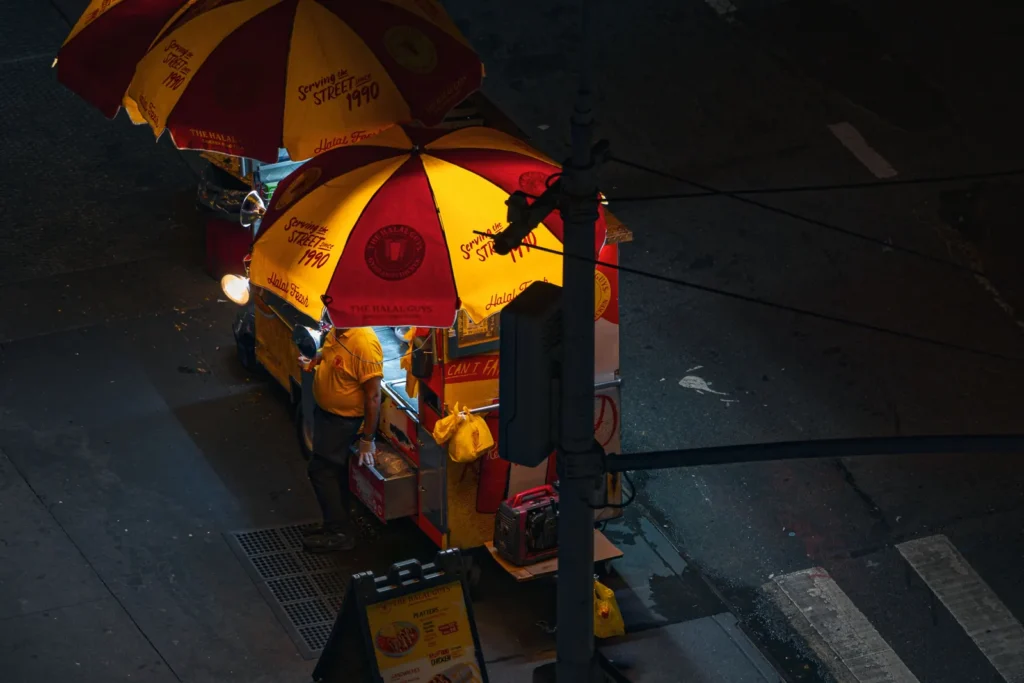
Search for cheap eats in New York and you will find a hundred guides promising meals under $10. Most of them list the same handful of places. Almost none of them checked a price before publishing.
We checked, and the checking turned out to be the story. The Halal Guys regular platter, the dish that anchors nearly every one of those lists, is priced at $15.99 on the ordering listing the company links to from its own website. Prince Street Pizza does not publish a slice price anywhere on its official menu. Gray’s Papaya has no website at all. And visitor reports for that same Halal Guys platter, over the past couple of years, quote $7, $8, $8.99, $9, $12.99 and $19.
That does not mean New York has stopped being affordable. It means nobody is actually checking, and the gap between the counter and the internet has become wide enough to ruin a plan. This article covers what things realistically cost, where cheap still genuinely means cheap, how to read a cart before you buy from it, and how to answer the halal and gluten-free questions that almost no guide touches.
The short answer
- The $10 street meal is mostly gone. Budget $10 to $16 for a full platter from a well-known cart.
- Most famous cheap-eat spots do not publish prices online. Not on their own sites, anyway.
- The cart and the delivery app are not the same shop. Different prices, and sometimes a different menu.
- Every legal cart carries a letter grade from the NYC Health Department, printed on its permit decal.
- Chinatown is where the real numbers still are, and where the fewest prices are online.
- Assume cash. Assume tax on top. Assume the posted price is not the final price.
What “cheap” actually means in New York in 2026
The under-$10 street meal is now the exception rather than the rule. Not gone, but no longer the default, and no longer what the famous places charge.
Here is the problem with checking. Almost none of the best-known cheap-eat spots publish a price on their own website.
|
Place |
Prices on its own site? |
|---|---|
|
The Halal Guys |
No. Menu items shown without prices |
|
Prince Street Pizza |
No. Full menu with descriptions, no prices |
|
Gray’s Papaya |
No website |
What each of them does have is a delivery listing, and that is where the published numbers live. The Halal Guys links to four of them from its own location page.
So we went looking for the counter price, and found the second half of the problem.
One platter, six prices
- Visitor reports posted across review sites over the past couple of years quote $7, $8, $8.99, $9, $12.99 and $19 for a Halal Guys platter
Some of that is inflation. Some of it is people comparing a small platter with a regular one without saying which. And a good part of it is that some of those figures are delivery orders and some are the cart.
Where a company publishes a figure, we give it and say where it came from. Where it does not, we give the range visitors report and label it as exactly that.
What we will not do is pick one number out of that spread and present it as fact, which is what a lot of guides have done. A guide that tells you a platter is $8 sends you to a cart with a ten-dollar bill in your hand and forty people behind you in the line.
The Halal Guys, and what a platter actually costs
The cart on the corner of West 53rd Street and 6th Avenue is where this whole category starts. It has been there since 1990, and it is now the origin point of a global franchise.
Hours, from the company’s own location page
|
Days |
Hours |
|---|---|
|
Monday to Thursday |
10:00 am to 4:00 am |
|
Friday and Saturday |
10:00 am to 5:00 am |
|
Sunday |
10:00 am to 4:00 am |
Those are unusually long hours, and they are why this cart appears in so many late-night stories. It is one of the few places in Midtown where you can eat properly at three in the morning.
Prices, from the ordering listing the company links to
|
Item |
Price |
|---|---|
|
Regular platter |
$15.99 |
|
Small platter |
$12.99 |
|
Sandwich |
$10.99 |
|
Lamb and beef gyro sandwich |
$13.99 |
|
Falafel, six pieces |
$5.79 |
|
Hummus |
$5.79 |
|
French fries |
$4.79 |
|
Baklava |
$3.79 |
Every platter and sandwich starts with lettuce and tomato, rice, and your choice of chicken, beef gyro, falafel or a combination.
This is the single most useful thing to understand here, and no guide says it.
Visitor reports put the counter price for a platter somewhere between roughly $9 and $13, against $12.99 to $15.99 on the delivery listing. Budget around $10 to $13 at the cart and you will not be caught out. We could not find a counter price published on any official source, and we are not going to invent one.
The menus differ too. The delivery listing offers a lamb and beef gyro; visitors report the cart itself serving chicken and beef only. And where the listing describes sealed sauce packets, people at the cart describe sauce bottles on the side that you dispense yourself.
On the hot sauce. It is genuinely hot. If it comes sealed, add it a little at a time. If it is a bottle you are pouring yourself, be more careful still. Several people describe ruining a platter with it, and you cannot take it back out.
On allergens. The company lists casein, soy, pea, mustard and sesame. That list is on the ordering page, not on the cart.
Pizza by the slice, and what the menus do not tell you
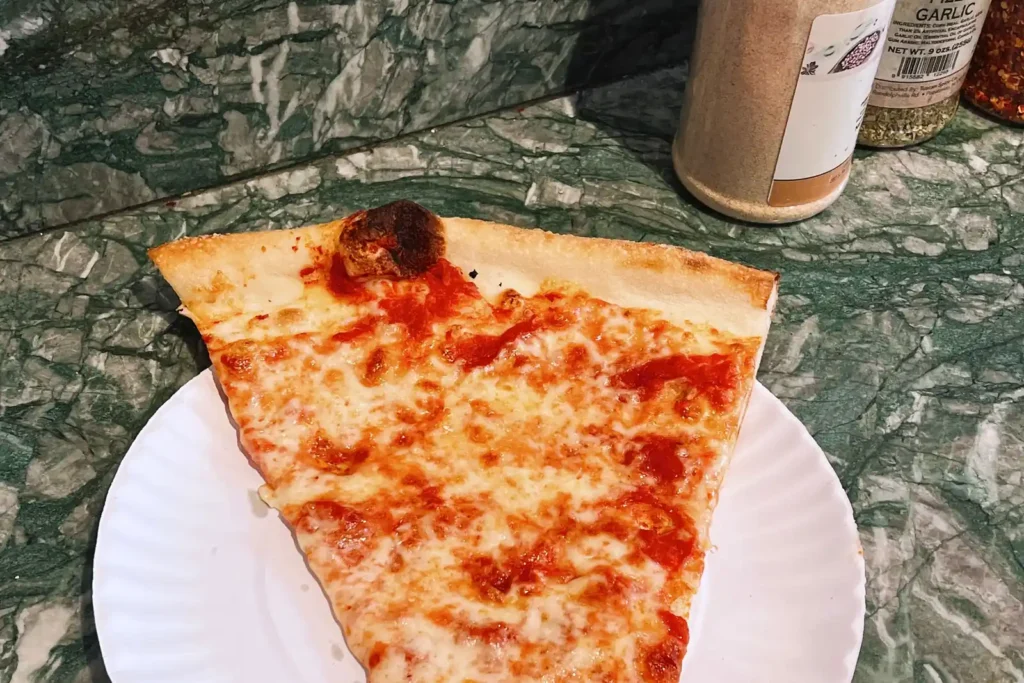
The dollar slice is the most repeated claim in New York food writing and the hardest to verify. Slice shops rarely have websites, and when they do, the prices are not on them.
Prince Street Pizza is the famous one, at 27 Prince Street in Nolita, open since 2012. Its Sicilian squares are sold by the slice or as a whole pie. The Spicy Spring is the slice people queue for: fra diavolo sauce, spicy pepperoni, fresh mozzarella.
Two things on its official menu are worth reading before you order, and neither appears in any guide we found.
Prince Street’s menu lists a spicy vodka sauce that contains prosciutto. If you avoid pork, the topping is not the only thing to read.
On the gluten-free option. A gluten-free version of the Spicy Spring exists. The menu also states plainly that gluten-free products are cooked in facilities where gluten is present. That is the difference between “gluten-free” and “safe for coeliac disease,” and the restaurant says so itself.
For the genuinely cheap slice, you are looking for a plain counter with a hot case and no queue of tourists. Those places have no websites, no delivery listings and no presence in guides. The price is on a board behind the counter, and that board is the only reliable source there is.
Chinatown, where cheap still means cheap
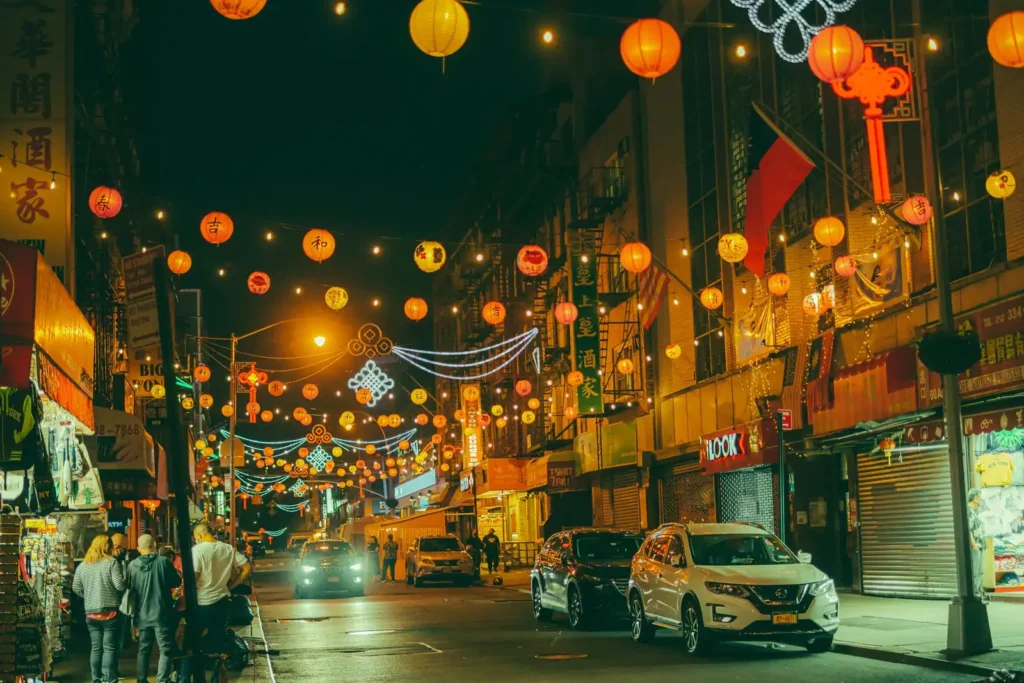
If you want the sub-$10 meal the guides promise, Manhattan’s Chinatown is where it still exists. It is worth understanding what is actually there before you go, because “Chinatown” covers several very different kinds of eating.
The cuisines. Cantonese and Fujianese dominate, and you will also find Taiwanese, Vietnamese, Malaysian, Laotian and Cambodian food in the same few blocks. Manhattan’s Chinatown now has the smallest population of the city’s three Chinatowns, but it remains the borough’s centre for Chinese food.
Three kinds of place, and they are not interchangeable
|
Kind |
What it is |
Budget |
|---|---|---|
|
Dim sum parlour |
Sit-down, many small plates, built for groups |
Mid |
|
Traditional restaurant |
Full Cantonese menus, larger dishes, family-style |
Mid to higher |
|
Small storefront |
Dumplings, buns, bao, noodles. Grab and go |
Lowest |
The small storefronts are where the cheap eating happens. The dim sum parlours are where the experience is.
What dim sum actually means
It is not one dish. It is a spread of small plates eaten together, traditionally with tea. The things you will see most: har gow (shrimp dumplings in a translucent wrapper), shumai with pork or shrimp, rice noodle rolls filled with barbecue pork, leek dumplings, steamed buns, and custard tarts to finish.
There is one distinction worth knowing before you pick a place, and it changes the experience completely.
Cart service or a la carte. The old style sends waiters through the room pushing trolleys of steamer baskets, and you point at what you want as it passes. The modern style hands you a menu and cooks each dish to order.
- Nom Wah Tea Parlor, 13 Doyers Street, is the neighbourhood’s oldest dim sum parlour, open since 1920. It used carts for most of its life and switched to made-to-order in 2010. Vintage room, red booths, no trolleys
- Jing Fong, 202 Centre Street, is another historic Chinatown name that has downsized and modernised
- House of Joy, 28 Pell Street, still runs the old way. Carts wheeled through a large dining room by waiters in vests and bow ties, and tables that seat a dozen or more
If the trolleys are the thing you came for, that last one matters.
The practical part
- Weekends are the problem. Every dim sum parlour in Chinatown has long waits at weekends. Go early or go on a weekday
- Bring cash, in small bills. Many of the cheapest storefronts prefer or require it
- Read the board, not the internet. Prices are on the wall and they are current
- Look for the letter grade card in the window before you sit down. Every restaurant in New York has to display one
- Follow the lunch queue. A line of people on a work break is the most reliable signal in the neighbourhood
Almost none of these places publish prices on a site of their own, and the numbers floating around online are guides quoting guides. We would rather send you to the right streets with the right expectations than give you a figure we cannot stand behind. The board on the wall is the source.
Where to walk. Doyers Street is the short bent lane off the Bowery where Nom Wah sits, and Pell Street runs beside it. Both are lined with small businesses and both are a short walk from Canal Street station, served by the 6, N, Q, R, W, J and Z, or Grand Street on the B and D.
Chinatown is also a few blocks from the Manhattan end of the Brooklyn Bridge. If you are walking the bridge, the Centre Street entrance sits between the two, which makes lunch here and a crossing afterwards a natural half day.
Hot dogs, and what a cart actually is
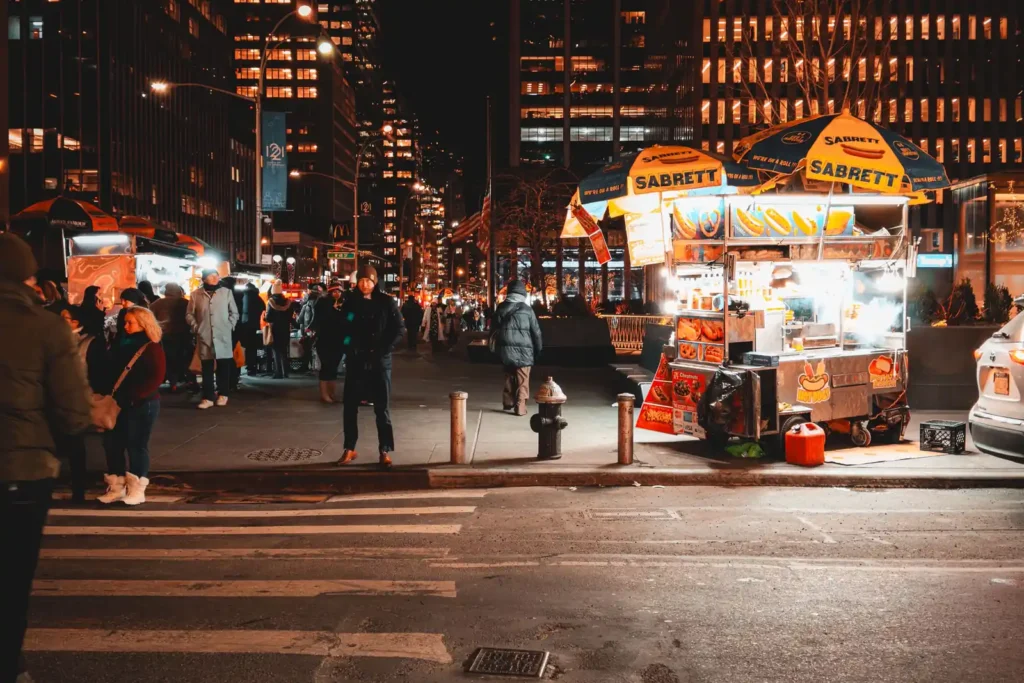
The New York hot dog is the cheapest recognisable meal in the city and the one people ask about most.
Two things are worth separating. There are street carts, individually licensed vendors selling from a permitted unit. And there are the sit-down papaya-and-hot-dog counters, of which Gray’s Papaya at 2090 Broadway is the survivor. It has been there since 1973. It has no website, and its prices are on the wall.
That is not a criticism. It is the point. These are businesses that do not need to be online, and any price you read about them elsewhere came from somebody’s memory.
What you can rely on: the hot dog counter is still among the cheapest hot meals in Manhattan, and the carts are cheaper still. What you cannot rely on is any specific number you read, including in this article, unless we could source it.
How to read a cart before you buy from it
This is the part no guide covers, and it is free, official, and takes four seconds.
Since December 2018, following a local law passed in 2017, every permitted food cart and truck in New York City is inspected and graded by the NYC Health Department on exactly the same scale as restaurants.
|
Score |
Grade |
|---|---|
|
0 to 13 points |
A |
|
14 to 27 points |
B |
|
28 or more points |
C |
Restaurants have had this since 2010, and their grade card has to be posted where people passing by can easily see it. That is the card in the window.
A few more things the Health Department publishes about how this works. Mobile vending permits are valid for up to two years and must be renewed. Inspections check compliance with the City Health Code and the State Sanitary Code, the same as for restaurants. And because carts move, the Department attaches location-sharing devices to permitted units so inspectors can find them.
Restaurant inspection results are published online and searchable, so if you are planning around a specific sit-down place you can look up its record before you go rather than discovering the grade when you arrive.
Halal, kosher, gluten-free and vegetarian
People search for this constantly, for almost every well-known place in the city, and the guides answer none of it. Here is what can actually be established.
Halal. Do not assume. “Halal” on a cart’s awning is a description the vendor has written, not a certification anybody checked. The Halal Guys is the exception among the famous names: the company publishes a halal certification page on its own website. For any other cart, you are relying on the vendor’s word, and how comfortable you are with that is your call.
Kosher. A different question, and the answer is usually no. Halal and kosher are not interchangeable, and a halal cart is not kosher. Kosher establishments carry their own certification, displayed.
Gluten-free. More widely available than it used to be, but read the wording. Prince Street Pizza offers a gluten-free version of its signature slice and states on its own menu that gluten-free products are cooked in facilities where gluten is present. That is honest of them, and it is the distinction that matters if you have coeliac disease rather than a preference.
Vegetarian and vegan. Falafel is the reliable street answer, and The Halal Guys sell falafel platters and sandwiches below the price of the meat versions. In Chinatown, Nom Wah marks gluten-free, vegetarian and vegan items directly on its menu, which is unusual for the neighbourhood and makes it a sensible first stop if you are managing any of those.
The rule underneath all of these. If it matters medically or religiously, ask at the counter rather than trusting any guide, including this one. A written source can tell you what a company published. Only the person handing you the food can tell you what is in it today.
Cash, cards, and the bits that catch people out
- Assume cash. Many carts, most Chinatown storefronts and a lot of slice shops still prefer or require it. Card acceptance at street level has improved but it is not universal, and a cart with a card reader may still have it out of service
- Assume tax on top. New York adds sales tax to prepared food at the register. The number on the board is not what you pay
- Tipping. At a counter or a cart, tipping is not expected the way it is at a table. A card reader may still prompt you
- Small bills help. A cart at peak lunch does not want a fifty
- Queues are information. A long line at a cart usually means fast turnover, which means the food has not been sitting. A cart with no line at noon on a weekday in Midtown is worth a second look
How to check a price before you travel
Since the guides cannot be trusted on this and prices move, here is the routine that works.
- Find the place’s own website first. If prices are there, that is your answer
- If not, open its delivery listing. The Halal Guys links to its own from its location page. Treat those prices as a ceiling, not a quote
- Then sort recent reviews by date and read the last few months. People mention what they paid. One review proves nothing; five recent ones clustering around a figure tell you the ballpark. Ignore anything older than a year
- Check the Health Department’s inspection results for sit-down places, so the grade is not a surprise
- Budget above the number. Add tax, add a drink, and assume the guide you read was written two years ago
Five minutes, and more reliable than any list, including this one, a year from now.
Questions people actually ask
Before you go
Eating cheaply in New York still works. What has stopped working is the promise that a famous name and a ten-dollar bill will get it done.
Go to Chinatown for the numbers, and to the small storefronts within it rather than the parlours if the budget is the point. Go to the carts for the hours and the convenience, with a realistic figure in your head. Look at the permit decal before you order. And treat every price you read online, this article included, as something to confirm rather than something to rely on.
Hours, rules, grading thresholds, neighbourhood detail and menu information verified against NYC Health, the MTA, NYC Tourism and the operators’ own sites on 3 September 2026. Where a price could not be found on an official source, we have said so and given the range reported by recent visitors on public review sites, labelled as such. Review figures are not treated as verified prices anywhere in this article. How we research every guide.