
PARKS & OUTDOORS
Brooklyn Bridge Park: Every Pier, What’s Free, and When Things Are Actually Open
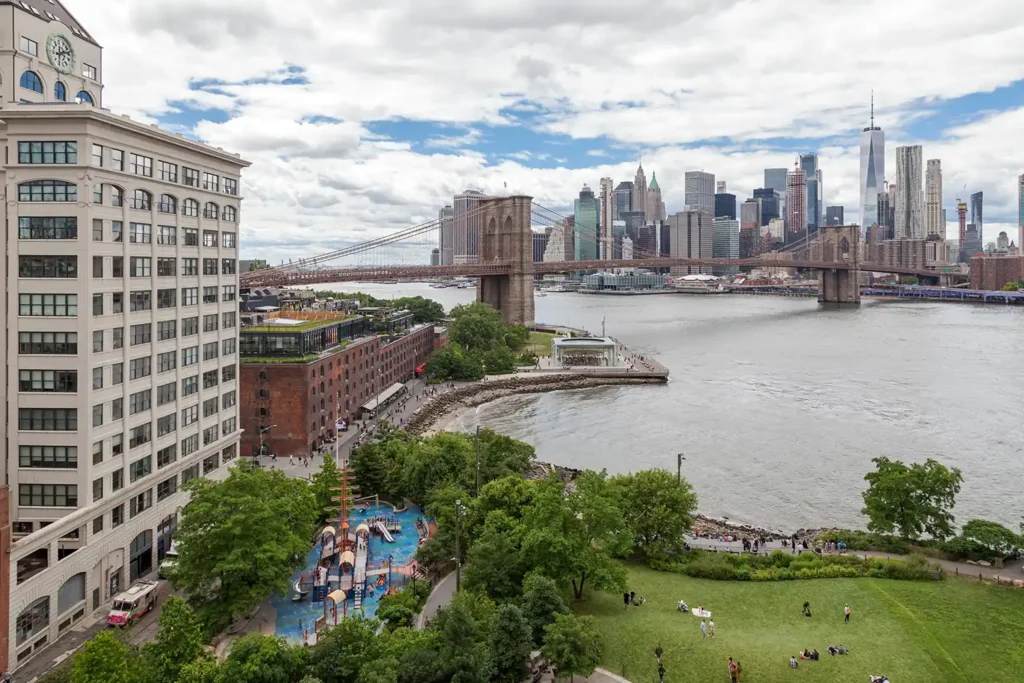
Brooklyn Bridge Park is open from 6 am to 1 am. That single fact appears in every guide to the place, and on its own it will mislead you.
The playgrounds close at sunset. Pier 2 shuts earlier than the park does, and earlier still in winter. The restrooms have their own hours, and they change with the season. Arrive at eight on a summer evening expecting to put the kids on the swings and you will find the gates shut while the park around you stays open for another five hours.
This guide covers what is on each pier, what costs money and what does not, when each part is actually open, and the one thing about Pier 4 Beach that at least one popular guide gets dangerously wrong.
The short answer
- Entry is free. No ticket, no booking, 365 days a year.
- The park is open 6 am to 1 am. Almost nothing inside it keeps those hours.
- Playgrounds close at sunset. In December that is around 4:30 pm.
- You cannot swim at Pier 4 Beach. It is a boat launch, and there are no lifeguards anywhere in the park.
- Kayaking is free but you must book two weeks ahead, and the schedule shrinks after August.
- The ice rink and the roller rink are two different rinks in two different places.
- Jane’s Carousel and both rinks are not run by the park, which is why they charge.
Hours: the park is open, but the thing you came for may not be
The park and the things inside it keep different hours. This is the single most useful thing to know before you plan a visit, and almost no guide mentions it.
|
Where |
Hours |
|---|---|
|
The park itself |
6 am to 1 am, seven days, 365 days a year |
|
Playgrounds |
Sunrise to sunset |
|
Pier 2 |
8 am to 11 pm, seasonal. Earlier in winter |
|
Pier 5 |
6 am to 11 pm |
|
Pier 6 volleyball courts |
6 am to 11 pm |
|
Environmental Education Center |
Thu and Fri 3 to 5 pm, Sat and Sun 1 to 5 pm |
|
Restrooms, March to October |
7 am to 11 pm |
|
Restrooms, November to March |
7 am to 10 pm |
Pier 2 is marked seasonal for a reason. Its listed closing time shifts through the year, so the basketball, pickleball and fitness equipment may be unavailable well before the park itself closes. At least one recent guide lists Pier 2 as closing at 9 pm rather than 11 pm, which is the sort of small error that costs you an evening.
Restrooms are at seven locations across the park, all of them fully accessible. Water fountains have bottle-filling features and are turned off once temperatures reach freezing.
Pier by pier: what is actually on each one
The park is built on former cargo piers, numbered 1 to 6 from north to south, plus the older Empire Fulton Ferry section at the northern end where the carousel sits. Each pier has a distinct purpose. Walking the whole length is about 1.3 miles one way.
Empire Fulton Ferry
Jane’s Carousel, Empire Stores, and the closest point to where the Brooklyn Bridge lands. This is where most visitors arrive and where most of them stop.
Pier 1
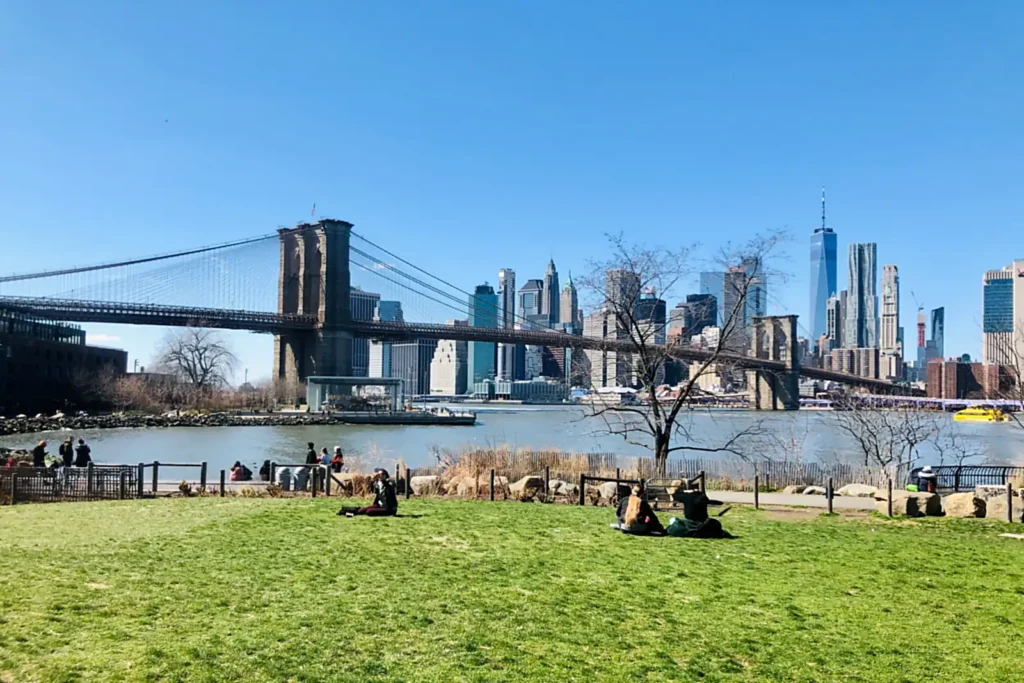
The widest and most park-like of the piers. Three separate lawns, a playground, a salt marsh, and the Granite Prospect stepped seating that looks straight across at Lower Manhattan. The waterfront path here gives you the skyline, the harbour and the bridge in one view.
Pier 2
Covered active recreation under a roof. Basketball, handball, ping pong, pickleball, fitness equipment, swing sets, a play turf, and picnic tables. The roller skating rink is here, and so is the floating dock used for free kayaking.
Restrooms, lockers, water fountains and bike racks are all on site, and the whole pier is ADA accessible. The roof means you can keep playing after sundown. Courts can be reserved for basketball, handball and ping pong, and permits may carry a fee.
Pier 3
A large central lawn sheltered from wind and sun by groves of trees, and along the north side an exploratory labyrinth with interactive features and picnic tables.
Pier 3 Plaza is a separate open space, used for skateboarding, with an unobstructed view of Lower Manhattan. Worth knowing if you came for quiet: the plaza is not it.
Pier 4 Beach
A small beach with man-made tidal pools built to encourage marine life. Its purpose is launching human-powered boats, not swimming. See the next section.
Next to the beach are the remnants of a railroad float transfer bridge, left in place. Goods that landed at the Lackawanna Terminal in New Jersey were floated across the harbour and came ashore here.
Pier 5
Sports fields and the Picnic Peninsula. Grills, picnic tables, and the Harbor View Lawn. At the far end there is a designated fishing station with bait preparation tables and fish cleaning stations.
Lockers here are free. There are restrooms in the Boathouse building at the Pier 5 Uplands, and a smaller playground built for toddlers.
Pier 6
The family end of the park. Slide Mountain, Sandbox Village, Swing Valley and the Water Lab, plus the nearby Exploratory Marsh. Three regulation-size sand volleyball courts, open to drop-in play or league matches.
NYC Ferry stops here, and so does the ferry to Governors Island. The B63 bus stops just outside 360 Furman Street.
Pier 4 Beach: you cannot swim here
Swimming and wading are not permitted at Pier 4 Beach. This is worth stating plainly, because at least one popular guide describes it as a swimming beach that operates in summer. It is not, and the reasons are serious.
Why swimming is prohibited
- Strong currents
- Ship traffic
- Cold water temperatures
- Water pollution
- There are no lifeguards anywhere in the park
What the beach is for is launching kayaks, canoes and other human-powered boats. Note that New York City requires a permit to use any city launch facility, so bringing your own boat is not simply a matter of turning up. If you are launching from Pier 4, paddle north past Pier 3 before heading out into the river, to stay clear of boat traffic from the nearby marina.
People still search for it, and guides published as recently as this year still list “a pop-up pool in summer” among the park’s features. A temporary pool did exist here, but it closed in 2018 when the Pier 2 Uplands were built. There is nowhere to swim in Brooklyn Bridge Park.
Free kayaking, and how to actually get a slot
Kayaking in the park is completely free. It is run by the Brooklyn Bridge Park Boathouse, an independent volunteer-run nonprofit, in partnership with the park. Life vests, boats and instruction are all provided, and first-time paddlers are welcome. There are safety boaters on the water, and the kayaks are stable enough that falling in is rare.
You paddle in the protected embayment between Piers 1 and 2, for about twenty minutes, from a floating dock at the north entrance of Pier 2 near the roller rink.
The season has a shape, and it is not the same all summer
|
When |
What runs |
|---|---|
|
Last Wednesday in May through August |
Wednesday and Thursday evenings 5 to 7 pm, and Saturdays 10 am to 3 pm |
|
Sundays through August |
Kids and family sessions only |
|
Labor Day weekend |
Closed |
|
September |
Saturdays only, 10 am to 3 pm |
Most guides describe the summer schedule and stop there, so a visitor arriving on a Wednesday evening in September finds the dock closed. From September the programme runs on Saturdays only.
Booking is the part people get wrong. Registration opens exactly two weeks ahead of each date, on a rolling basis, through the Boathouse website, and slots go quickly. If nothing is available there is a standby form, and walk-up spaces sometimes open through cancellations and no-shows. Holiday weekends may be skipped entirely.
Rules for children
- Anyone under 18 needs an adult guardian present
- Single kayaks are for adults, or for a paddler aged at least 14 with a guardian present
- Doubles take one adult plus no more than one child under 14
The Sunday family sessions work differently, and this is the detail worth knowing if you have children. Through August, kids aged 7 and over can paddle a single kayak solo as long as a guardian is present, because extra on-water safety boaters from The Kayak Foundation are there, specially trained to work with children.
Two practical warnings. Expect to get wet from the waist down, so bring a change of clothes. There are restrooms in the orange building at Pier 2 where you can change, and lockers for 25 cents. And sessions are cancelled for weather, sometimes at short notice, because conditions on the water change fast.
Ice skating and roller skating are two different rinks in two different places
This trips people up constantly, including guides that should know better.
|
Roebling Rink |
Pier 2 Roller Rink |
|
|---|---|---|
|
Surface |
Ice |
Roller |
|
Where |
Emily Warren Roebling Plaza, under the Brooklyn Bridge |
Pier 2, under the roof |
|
Season |
Winter pop-up, roughly late November to early February |
Seasonal |
|
Cost |
Ticketed |
Ticketed |
Neither rink is run by the park itself, which is why both charge while the park is free.
Roebling Rink is a seasonal pop-up on Emily Warren Roebling Plaza, sitting directly beneath the bridge with the harbour and skyline behind it. It first appeared in November 2023 under the name Glide at Brooklyn Bridge, after Brooklyn Bridge Park Corporation ran a search for an operator to build a rink on the plaza. It has returned each winter since, and in its second season sold more than 150,000 tickets across a fourteen-week run.
Sessions are booked online for a fixed interval on the ice, with skate, helmet and skate-buddy rental available. Private lessons run through Fireworks Skating Academy, and school groups can book private sessions.
Roebling Rink releases a limited number of free tickets to New York City residents during selected sessions. They go on a first-come, first-served walk-up basis and you need valid ID showing city residency.
Dates, prices and the free-ticket schedule are announced fresh each autumn, so there is no point printing last winter’s numbers here. Check the rink’s own site before you plan a trip around it.
Pier 2 Roller Rink is open-air but sheltered under Pier 2’s roof, with adjustable skates and Skate Mates for beginners, a cafe, themed events and birthday party packages. It has its own website for hours and prices.
Jane’s Carousel
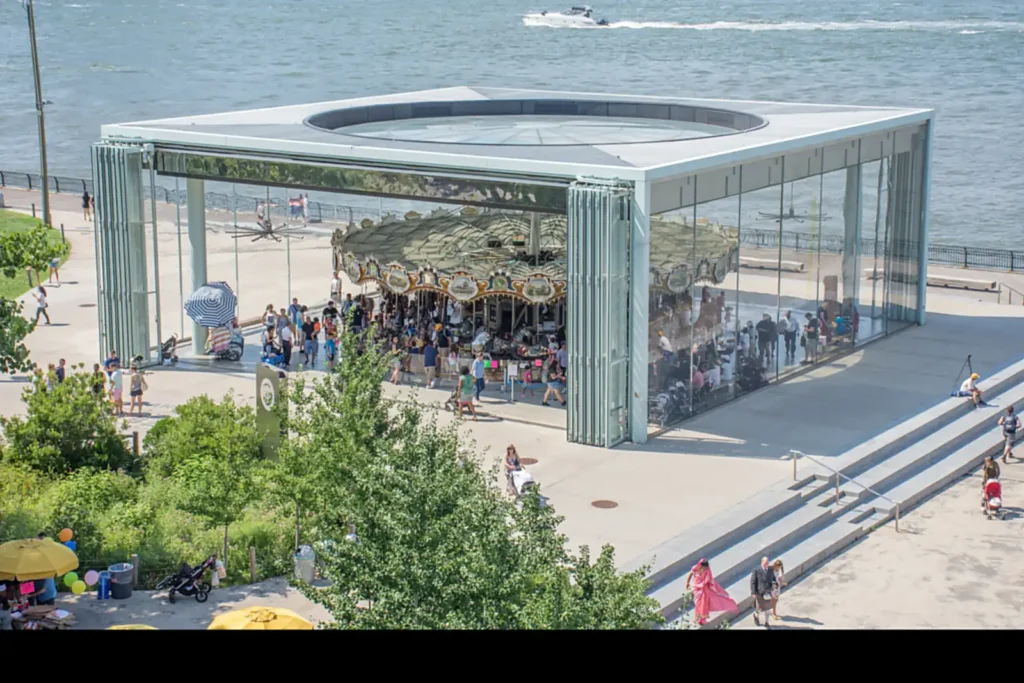
A working 1922 carousel sits in a glass box at the northern end of the park, and the story of how it got there is better than the ride.
It was built by the Philadelphia Toboggan Company as their machine number 61, and installed at Idora Park in Youngstown, Ohio, a steel town then doing well. It was called the Idora Park Merry-Go-Round. Three rows, forty-eight carved wooden horses, thirty of them jumpers and eighteen standers, plus two chariots.
When Idora Park closed the carousel went to auction in 1984 in poor condition, and Jane and David Walentas bought it whole.
Jane Walentas then led its restoration from her studio in DUMBO. The work involved carpentry repairs and hand-scraping layer after layer of later paint off the horses. Underneath, the original 1922 colours and the wood carving were still there. She matched paint to what she uncovered and replaced the missing ornament.
Here is the part that surprises people who assume they are looking at a replica. The scenery panels, the rounding boards, the crests, the centre pole and the platform are all original to the 1922 machine.
The Walentases commissioned the French architect Jean Nouvel to design a glass pavilion so the carousel could run year-round. It opened to the public in the park on 16 September 2011, and it is maintained and operated by Friends of Jane’s Carousel, a nonprofit set up to guarantee its upkeep for up to thirty years.
It is ticketed and it is not run by the park, so its hours shift with the season and are worth checking on its own site before you go.
Getting there, parking, bikes and lockers
Subway
Three stations serve different ends of the park.
|
Line |
Station |
Best for |
|---|---|---|
|
A, C |
High Street |
The north end, Pier 1 and the carousel |
|
F |
York Street |
DUMBO and the northern edge |
|
2, 3 |
Clark Street |
The middle of the park |
The 4/5 and R also serve the wider area, and the B25, B61, B63 and B67 buses stop nearby.
Ferry
NYC Ferry stops at DUMBO/Fulton Ferry on the East River route, and at Brooklyn Bridge Park Pier 6/Atlantic Avenue on the South Brooklyn route. The Governors Island ferry also runs from Pier 6.
Parking, bikes and lockers
- Parking is limited and discouraged. There are two paid garages in the park, one near Pier 2 and one near Pier 6 on the south side of 360 Furman Street
- Bikes may only be ridden on the designated Greenway path. Everywhere else, including the pier promenades and Squibb Bridge, you must dismount and walk
- Bike racks are at each park entrance and near park buildings. Bikes left overnight are removed
- Shared scooters may not be ridden inside the park at all
- Lockers cost 25 cents at Pier 2 and are free at Pier 5. Nothing may be left overnight
Accessibility
The park describes itself as entirely ADA accessible. Restrooms are fully accessible, benches have handrails and backs, and companion seating is available. The play areas at Piers 1, 2 and 6 have accessible swings and ground-level equipment, and the Main Street playground has ramped equipment. The original ramp in Squibb Park has been re-graded for ADA access and Squibb Bridge itself is accessible. All three ferry landings are accessible.
For Access-a-Ride, use 1 Water Street at the corner of Old Fulton and Water Street for Pier 1, and 360 Furman Street for the southern end.
Lost property
Complete the form on the park website, or drop found items at the Park Enforcement Police office at 99 Plymouth Street during business hours.
Food, grilling and picnics
The Picnic Peninsula on Pier 5 is the main grilling spot: shaded tables and open grills, first come first served. You cannot bring your own grill, and you cannot reserve a table or grill area.
One rule that is easy to miss: when the grilling area is busy, the park asks that each grill is used for one hour at a time.
The park has picnic tables and lawns throughout, and most people simply bring food in. There are also concessions in the park and restaurants immediately outside it, including Empire Stores at the northern end where Time Out Market sits inside the restored warehouse.
Groups larger than twenty need a permit, as do a number of other organised activities.
Why there are apartments in a public park
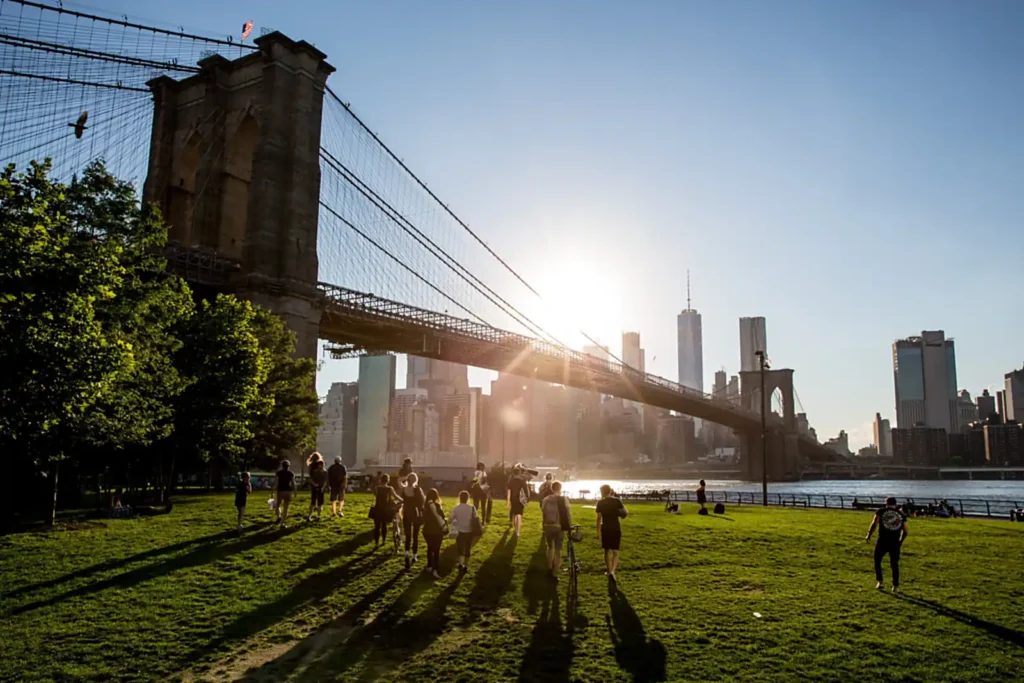
Visitors notice the residential towers and assume something went wrong. It did not. It is the design.
One of the founding principles of Brooklyn Bridge Park is that its annual operations and maintenance budget has to be financially self-sustaining rather than funded from city tax revenue. The development inside and along the edge of the park is what pays for the park.
Whether that was the right trade is a live argument in Brooklyn. But the buildings are not an intrusion into the plan; they are the reason the plan works.
Questions people actually ask
Before you go
Brooklyn Bridge Park rewards knowing its schedule more than almost any free attraction in the city. Check the sunset time if you are bringing children, book kayaking two weeks out if you want it, and know which rink you are actually going to.
The park will still be open at midnight. The swings will not. And if you are walking over from Manhattan, the Brooklyn Bridge walk lands you at the northern end of the park, which makes the two a natural single afternoon.
Hours, fees, pier detail, kayaking rules, accessibility and carousel history verified against Brooklyn Bridge Park’s own site and the Brooklyn Bridge Park Boathouse on 3 September 2026. Seasonal hours, rink dates and prices change every year, so confirm on the official site before you travel. How we research every guide.

